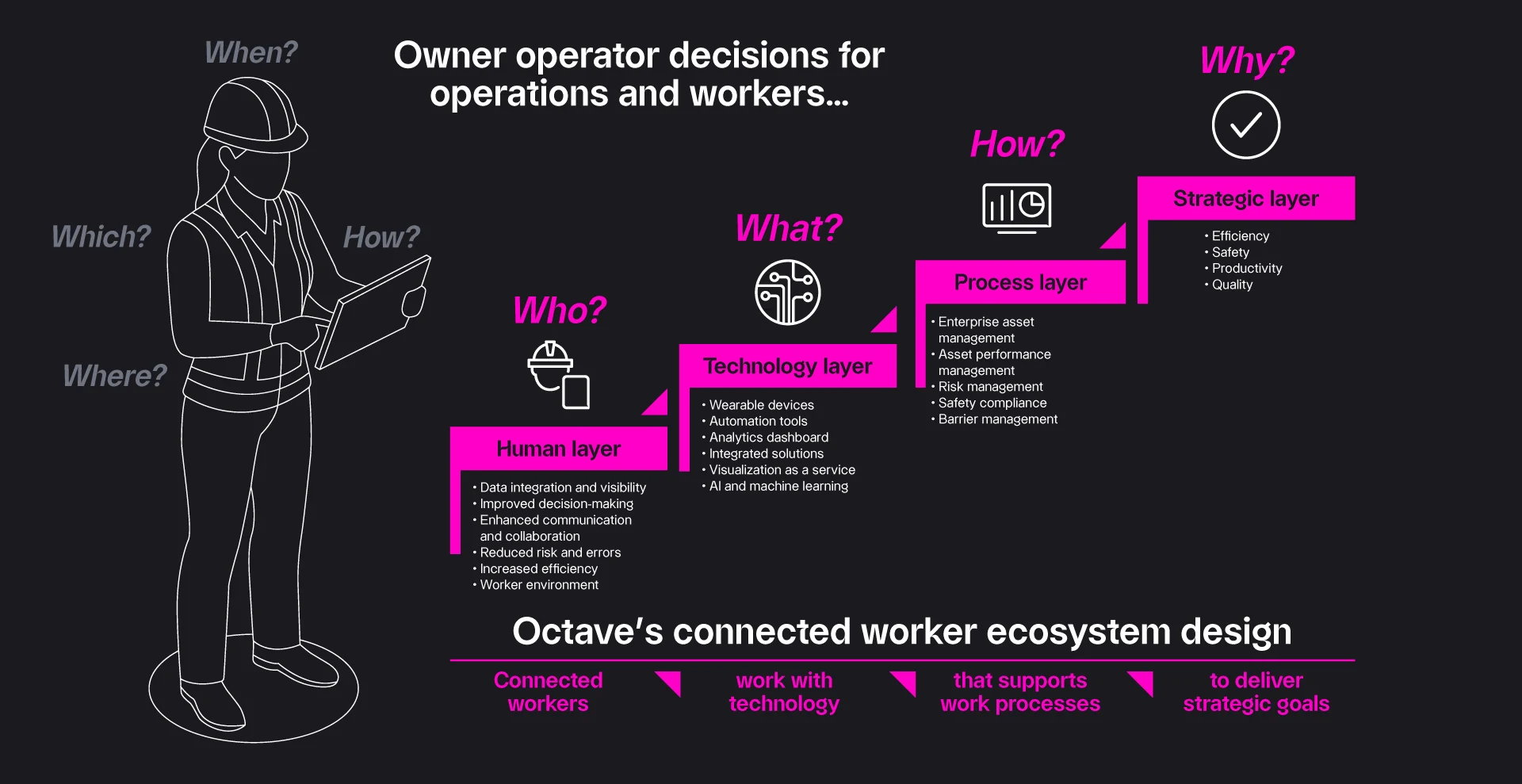
Welcome back to our blog series on Octave's human-centered connected worker (CW) ecosystem. In this blog, we spotlight the technology layer—the driving force behind CW solutions that deliver personalized experiences, real-time insights and seamless interoperability.
Enhancing Octave's CW solutions through technology
Octave's CW ecosystem comprises four interconnected layers, each essential to delivering comprehensive, human-centric solutions. At its core, the technology layer answers a fundamental question: "What technological capabilities are needed to enable optimal human-centered connectivity?" Central to this layer is the SMART WORKS technology selection model, which defines technical requirements based on the most critical connected solution functionalities, ensuring the chosen technologies align with the unique demands of the CW environment.
In our previous blog, we introduced Octave's process-driven architecture—a five-tiered framework designed to synchronize workflows from strategic planning to task execution. The technology layer enables the process design layer, providing essential technical functionalities that deliver the greatest value at every level.
Technology alignment with business goals is critical for successful digital transformation. According to McKinsey & Co., companies that integrate digital technologies can increase their earnings before interest, taxes, depreciation and amortization (widely known as EBITDA) by up to 26%, demonstrating how strategic adoption supports profitability. Similarly, a 2023 Deloitte report highlights a 25% productivity increase and a 22% improvement in safety when organizations integrate advanced technologies, further underscoring the relevance of Octave's strategic approach to CW solutions.
Organizations can define and prioritize the most critical technology requirements by using the SMART WORKS framework to review operational goals, process objectives and individual job performance targets. This ensures essential technical capabilities support CW solutions, ultimately delivering impactful and user-centered functionalities.
The three dimensions of CW solutions
The full potential of CW solutions emerges when they address three core dimensions:
CW centricity
Real-time access and analytics
Integration and interoperability
These dimensions form the foundation for effective, scalable CW investments. Given the high percentage of digital transformation initiatives that fail to meet expectations, aligning CW solutions with these dimensions is critical to addressing challenges and achieving meaningful results.
Dimension 1: CW centricity
CW Centricity emphasizes designing solutions that address workers' needs, preferences and challenges by ensuring tools are intuitive, relevant and engaging. Organizations adopting the centricity principle can foster higher adoption rates, increased satisfaction and improved productivity. Safety-oriented tools, engaging workflows, personalized interfaces and role-based learning are a few tactics that promote a worker-centric environment.
CW centricity
Human-centered design
Explanation: Success depends on user acceptance. Tools designed around workers' needs are more intuitive, relevant and easier to use.
Challenge addressed: Poor user experience, which often leads to low adoption rates.
Impact: Research suggests that 70% of software implementations fail because of user experience challenges.
Increased adoption
Explanation: Personalization helps workers engage more comfortably with digital tools and workflows.
Challenge addressed: Lack of personalization, which can reduce engagement and participation.
Impact: Studies have shown that personalized experiences can significantly improve user engagement and adoption rates by 62%.
Enhanced productivity
Explanation: Supportive technologies help workers perform tasks more efficiently while improving job satisfaction.
Challenge addressed: Inadequate training and support, which often results in underutilized technology investments.
Impact: Only 6% of companies have a mature approach to digital adoption.
Dimension 2: Real-time access and analytics
Real-time access and analytics equip workers with actionable insights that optimize decision-making and enhance their capabilities. This dimension uses advanced analytics and automation to improve productivity, identify trends and enable proactive issue resolution.
Real-time access and analytics
Timely decision-making
Real-time data helps workers and leaders make faster, more informed decisions in dynamic operating environments.
Proactive issue resolution
Analytics help identify potential issues early, allowing organizations to address problems before they escalate and cause disruption.
Operational efficiency
Actionable insights and streamlined workflows help teams work more efficiently and focus on higher-value activities.
Dimension 3: Integration and interoperability
Integration and interoperability ensure systems and technologies work harmoniously, facilitating comprehensive data exchange, more sophisticated collaboration opportunities and the adaptive capacity to succeed in connected environments. Scalable platforms and unified workflows eliminate silos and improve cross-functional efficiency.
Integration and interoperability
Integration and interoperability ensure systems and technologies work harmoniously, facilitating comprehensive data exchange, more sophisticated collaboration opportunities and the adaptive capacity to succeed in connected environments. Scalable platforms and unified workflows eliminate silos and improve cross-functional efficiency.
Seamless data exchange
Connected systems enable information to flow freely across the organization, providing a more complete and accurate view of operations.
Challenge: Siloed data systems can limit visibility, slow decision-making and hinder collaboration.
Impact: More than 80% of organizations identify data silos as a barrier to achieving operational excellence.
Cross-functional collaboration
Integrated technologies support teamwork across departments, helping employees share information, coordinate activities and work toward common goals.
Challenge: Compatibility issues between systems can restrict workflows and create communication gaps.
Impact: Approximately 31% of leaders report that most work within their organizations is performed by cross-functional teams.
Scalability and flexibility
Adaptable solutions make it easier to incorporate new technologies and evolving business requirements with minimal disruption.
Challenge: Lack of standardization can complicate system integration and slow transformation efforts.
Impact: Around 80% of frontline workers cite insufficient workplace connectivity, flexibility and autonomy as barriers to effectiveness.
The three dimensions of connected worker solutions—connected worker centricity, real-time access and analytics and integration and interoperability—form the essential pillars for successful connected worker solutions. By focusing on these dimensions, organizations base solution design on delivering a holistic approach that resolves common challenges and enables connected workers to concentrate on higher-value activities, ultimately enhancing productivity and engagement by eliminating mundane tasks.
Introducing the SMART WORKS technology selection framework
With a thorough understanding of the three essential dimensions of human-centered connected worker ecosystems—we now turn to how Octave's SMART WORKS technology selection framework ensures technology choices align with these dimensions.
This framework continuously meets the evolving requirements of CW solutions. It offers a strategic, holistic approach to technology selection that prioritizes user needs, optimizes operational efficiencies and promotes seamless integration. By using the SMART WORKS framework, organizations can navigate the complexities of digital transformation, ensuring that their technology investments drive meaningful and sustainable outcomes.
These attributes form the foundation of SMART WORKS, ensuring technical solutions meet human-centered needs.
How Octave's products align with SMART WORKS
Octave solutions, including Octave Tempo Operating Procedures (formerly AcceleratorKMS), Octave Reliance (formerly ETQ Reliance), Octave Attune EAM (formerly HxGN EAM), Octave Tempo Operations Management (formerly j5 Operations Management Solutions) and Octave InConcert (formerly HxGN SDx2), align seamlessly with the SMART WORKS framework. They enhance CW centricity, provide real-time insights and ensure seamless integration, enabling organizations to achieve higher adoption rates and operational efficiency.
The SMART WORKS technology selection framework in action
Safety and compliance (S) – Octave Reliance helps organizations strengthen safety performance through intuitive incident reporting, real-time monitoring and streamlined compliance workflows integrated with day-to-day operations.
Mobile access and connectivity (M) – Tempo Operations Management mobile capabilities keep workers connected with personalized notifications, real-time information and seamless access to enterprise systems from anywhere.
Advanced technologies (A) – Attune APM applies AI, machine learning, IoT data and predictive analytics to help organizations make better decisions and integrate emerging technologies at scale.
Real-time data and analytics (R) – Tempo Operating Procedures provides workers with task-specific information while enabling real-time data collection and analytics that support faster, more informed decision-making.
Training and development (T) – Tempo Operating Procedures delivers role-specific learning, on-demand knowledge and real-time feedback to help workers develop skills and perform tasks confidently.
Work order and task management (W) – Attune EAM streamlines maintenance and operational workflows through user-centric task management, automation and improved visibility into work priorities.
Operational efficiency (O) – Attune EAM combines intuitive workflows, dashboards and predictive analytics to help organizations maximize the efficiency and performance of assets throughout their lifecycle.
Remote support and collaboration (R) – InConcert enables real-time virtual collaboration and remote assistance, helping teams resolve issues faster and reduce operational downtime.
Knowledge management (K) – Tempo Operating Procedures provides easy access to current procedures, standards and operational knowledge while helping eliminate information silos.
Security (S) – Octave Protect strengthens cybersecurity through user-focused security controls, real-time threat detection and secure integration with existing IT and operational technology environments.
Technology layer conclusion
Octave's SMART WORKS technology selection framework demonstrates a deep commitment to aligning technology implementation with human-centric needs, ensuring innovative, practical solutions that are easy to adopt. Octave illustrates how human-centered strategies can deliver measurable outcomes by enhancing productivity, safety and collaboration while reducing downtime.
When organizations implement Octave's solutions with a focus on human centricity, they can increase the predictability of success in driving digital outcomes. The results presented in this conclusion section underline that successful adoption depends not just on the technology itself but also on understanding, prioritizing and committing to the human factors that foster sustained engagement and long-term value.
Ready to empower your workforce with connected intelligence? Click to get in touch!
And come back for part four - to explore the human layer, the heartbeat of connected worker success.
Learn more:
Connected worker series - part one - empowering industrial evolution: the four layers of Octave's connected worker ecosystem
Connected worker series - part two - Octave's process-driven approach: human-centered connected worker solutions for the digital age
Connected worker series - part four - people first: the human layer in connected worker solutions