Why human-centered design (HCD) is the heartbeat of connected worker success
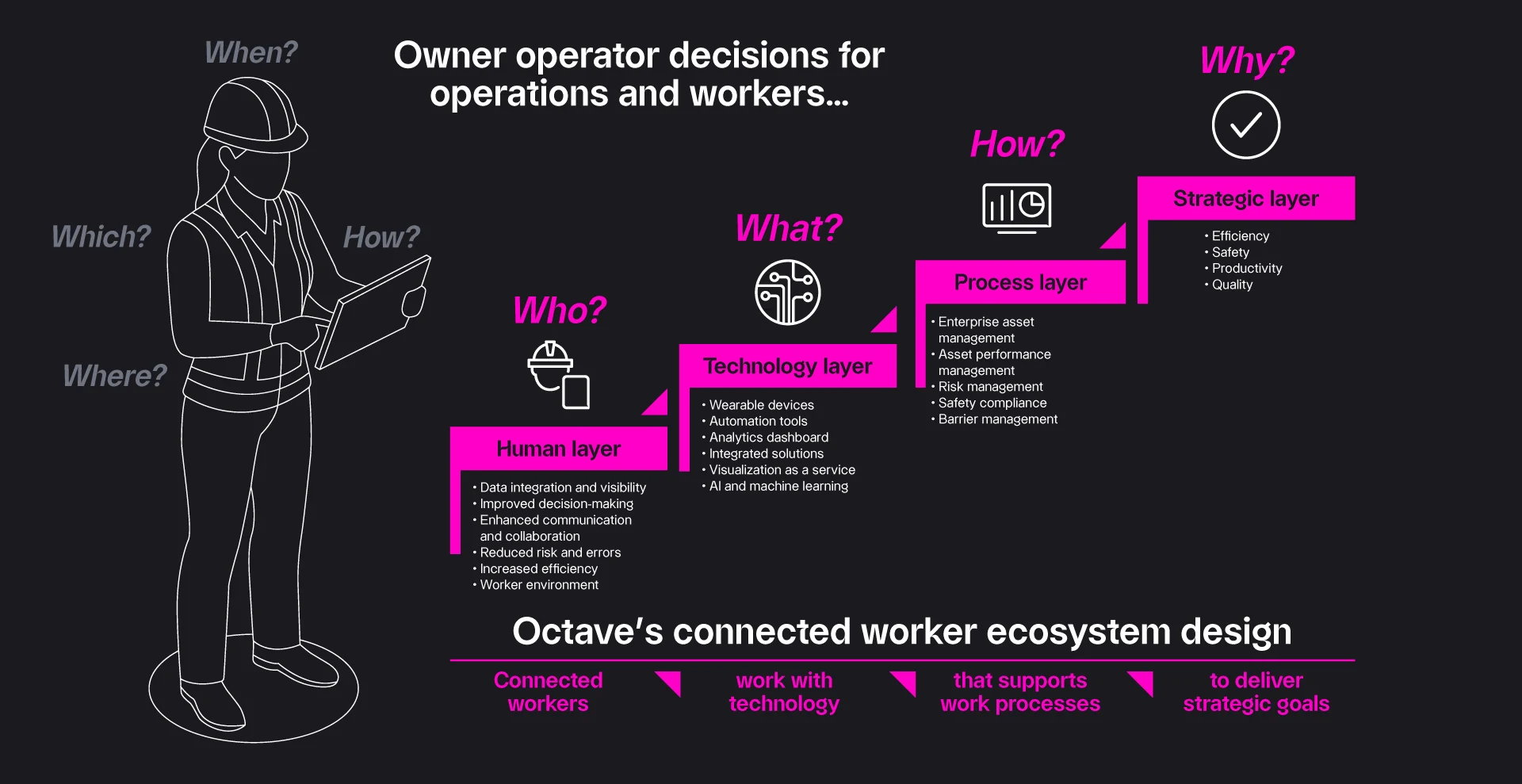
Welcome to the last of our series on Octave's human centered connected worker ecosystem. Throughout this series, we have explored our strategy for connected worker solutions, structured around four interconnected layers.
Today, we highlight the heart of the ecosystem: the human layer. This layer represents the end-user, or the "who." It ensures that HCD principles are embedded in every phase of the solution lifecycle—from initial concept ideation to ongoing evaluation and enhancement.
The human layer acts as a guiding force rather than an afterthought, making human-centricity the core of every solution at Octave.
Human-centered design: elevating productivity, safety and well-being
We believe technology should amplify human potential.
Our commitment to human-centered design places people at the core of our innovation strategy. This ensures that connected worker solutions enhance productivity and safety, and elevate job satisfaction and well-being. By evolving from product-centric to user-centric design approaches, we create environments where technology supports rather than overwhelms.
Here, we'll explore the fundamental HCD principles that shape the human layer. These principles ensure that connected worker solutions support the workforce—not just the technology. Across the Octave community, our mission is to create a future where technology and humanity evolve together, fostering innovation that resonates with and supports the people it serves.
Unlocking human potential: the core of Octave's design philosophy
By intertwining human-centric design principles at every stage of development, we help transform technology into a powerful ally that amplifies human potential. This holistic approach, known as the user-centric design trio, coined by Brent Kedzierski, goes beyond merely deploying technology. It involves the combination of three essential principles: adding clear value by addressing real user needs and enhancing performance; naturally fitting into daily workflows by seamlessly integrating into users' existing routines and processes; and resonating with end users by ensuring that solutions are engaging, intuitive and satisfying. By crafting solutions that add clear value, seamlessly fit into daily workflows, adapt to changing needs, and resonate with end users, we foster emotional engagement and optimize experiences. This ensures that solutions are not only functional but also deeply aligned with the needs, behaviors and preferences of the users, leading to higher satisfaction, engagement and productivity.
The human layer is the foundation on which we build impactful and lasting connected-worker solutions, transcending mere functionality. This approach creates harmonious, connected environments where technology and people coexist and flourish.
Imagine a cutting-edge connected worker solution that looks perfect in theory but falls apart in practice because it fails to account for human factors. In today's dynamic work environment, connected workers often feel overwhelmed by content shock, shifting priorities and complex interfaces. This overload can lead to resistance, low adoption rates and change fatigue, undermining the intended effect of even the most advanced solutions.
The reality of the hypercompetitive attention economy amplifies these challenges and new solutions must be developed to capture and sustain worker engagement. In this context, overlooking the human element is not just a minor oversight but a critical flaw that can sabotage success from the start.
Human-centered design is the foundation of solutions that resonate, support and endure by prioritizing the people behind the connected technologies, ensuring they work smarter and feel valued—not burdened.
Human-centered design (HCD) and design thinking are closely aligned. Throughout the design process, HCD principles help teams better understand worker needs, improve usability and adoption, and create measurable business value. Applying these principles consistently enables organizations to evaluate success through metrics related to engagement, efficiency, safety and overall user satisfaction.
Beyond usability: reimagining connected worker solutions in the AI era
Despite decades of progress, most HCD efforts still focus primarily on usability. Even in more mature organizations and advanced solutions, organizations often apply user experience principles inconsistently. Yet, as connected workplaces become increasingly connected, complex, data-driven and AI-powered, focusing solely on usability and basic user experience is not enough. We must move beyond traditional HCD approaches to support today's connected workers and address deeper cognitive and emotional needs.
The cognitive demands of the AI workplace
In AI-driven environments, where cognitive automation will dominate, we must rethink how we support connected workers. Future solutions must go beyond basic interface design to focus on cognitive enhancement and emotional resilience at work. This means not only supporting mental processing and decision-making but also addressing the emotional and neurochemical factors that influence focus, motivation and well-being.
Connected workers now encounter an increasing array of contextual challenges that surpass mere usability concerns:
Information overload: Navigating vast amounts of rapidly changing data
Rapid skill acquisition: Continuously adapting to new technologies and evolving processes
Decision fatigue: Making critical choices under pressure, often with limited time
Cognitive switching costs: Managing the mental strain of shifting between tasks and systems
Trust in AI: Building confidence in and collaborating effectively with autonomous systems
To address these demands, we must design solutions that enhance cognition, reduce mental strain and support emotional resilience. By integrating neuroscience and learning science insights, we can create solutions that improve cognitive performance and emotional stability, enabling more intuitive, supportive, human-centric experiences that amplify human potential.
Integrating neuroscience and learning design: a cognitive support paradigm
To build solutions that support connected workers, we must move beyond intuitive interfaces and focus on creating cognitive support systems. This shift requires leveraging our understanding of how the brain processes information, adapts to new skills and builds resilience. Neuroscience principles offer invaluable insights into handling complexity, maintaining focus and managing stress. For example, eye-tracking can detect cognitive overload in real-time. Meanwhile, learning design principles facilitate effective knowledge transfer and personalized, accelerated skill development.
By blending neuroscience and learning design with HCD principles and a strong emphasis on psychological safety, we can develop solutions that:
Enhance human cognitive, creative and collaborative capacities
Prepare workers for the evolving skill economy
Foster resilience and adaptability in increasingly dynamic work environments
Proactively identify latent challenges that workers may not recognize
This approach enables us to move beyond merely addressing obvious user pain points. By understanding underlying cognitive processes, we can enable advanced systems to foresee and address these hidden challenges before they become apparent.
Imagine connected worker solutions that:
Dynamically adjusts its interface based on real-time cognitive load
Delivers targeted micro-learning modules to address cognitive bottlenecks
Provides non-judgmental feedback to foster a safe and supportive learning environment
By designing solutions that react to known issues and predict and mitigate latent challenges, we amplify mental clarity, reduce cognitive overload and create more intuitive, supportive and human-centric experiences. This proactive approach enables workers to succeed—even in the most dynamic and complex environments.
Creating a future-ready workforce
As automation advances, human work will increasingly focus on problem-solving, creativity and collaboration—both among people and between humans and machines. To meet increasing challenges, workers will need tools that support rather than hinder their cognitive capabilities. This shift from interface design to cognitive support reduces mental fatigue and maximizes engagement and well-being.
Conclusion
The future of connected worker solutions lies in advancing technology and reimagining how technology supports human performance and potential. We believe that human-centered design is not just a design philosophy—it is an imperative for sustainable success. By embedding human-centricity at every stage of solution development, we transcend usability and access deeper levels of cognitive support, emotional resilience and adaptive capability.
In an era of intensifying cognitive demands and automation reshaping work, connected worker solutions must do more than streamline processes and keep workers out of harm's way. They must enable workers to think, adapt and succeed. This means designing tools that reduce mental strain, foster engagement and build the confidence to navigate complex, data-driven environments.
Our commitment to a holistic human-centered approach ensures that every solution we create is not only technologically robust but also deeply attuned to the evolving needs of the modern workforce. By anticipating latent challenges and enhancing cognitive and emotional well-being, we build solutions that resonate with people—creating meaningful, intuitive experiences that stand the test of time.
As we continue to push the boundaries of human-centered innovation, we invite you to partner with us. Together, we can shape a future where technology amplifies human potential and fosters a culture of resilience, productivity and well-being.
Contact us today to discover how our approach to the human layer can transform your organization.
Read more:
Connected worker series - part one - empowering industrial evolution: the four layers of Octave's connected worker ecosystem
Connected worker series - part two - Octave's process-driven approach: human-centered connected worker solutions for the digital age
Connected worker series - part three - SMART WORKS framework: the key to effective connected worker technology selection