Join us on this compelling journey as we explore how Octave's connected worker ecosystem is shaping the future of industrial work, where technology and humanity work in harmony.
Octave's trailblazing role in evolving industry 4.0
Early connected worker solutions were limited to basic internet of things (IoT) devices, data collection and single-point solutions. These initial efforts faced significant challenges, including complex integration processes, data silos and a lack of focus on user experience and human-centered design.
Industry 4.0 is in full swing, and Octave is helping reshape the industrial landscape with its innovative connected worker ecosystem.
In the early stages of Industry 4.0, connected worker solutions were primarily characterized by isolated, standalone applications rather than fully integrated ecosystems. These initial offerings, which included basic IoT devices and rudimentary data-collection tools, operated independently.
Consequently, they faced significant hurdles such as inadequate data security, limited scalability and insufficient real-time data processing capabilities. This fragmentation led to complex integration processes and persistent data silos, severely undermining their effectiveness in the rapidly evolving and increasingly interconnected industrial environments. The lack of a cohesive and human-centered design approach further hindered their adoption and utility, highlighting the urgent need for more comprehensive and integrated solutions.
For example, early connected worker technologies often comprised separate devices and applications for different tasks, such as wearable sensors for safety monitoring, handheld devices for communication and individual software systems for data analysis. These disparate solutions offered no single plane of glass and hindered manufacturers from achieving seamless interoperability and efficient data flow across operations. The lack of integration also resulted in the underutilization of valuable insights from collected data, as they remained confined within isolated systems.
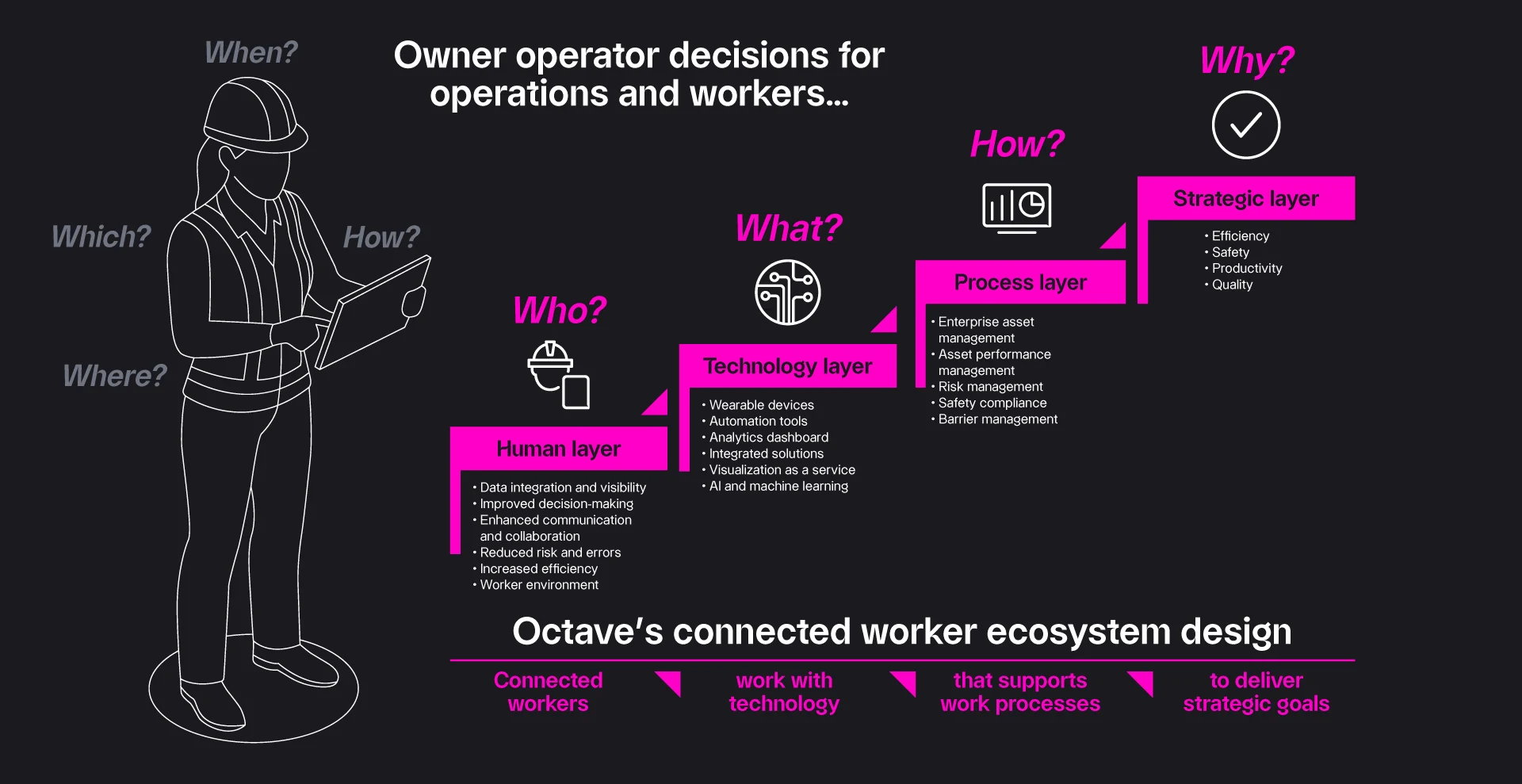
Recognizing these limitations, Octave developed a comprehensive four-layer connected worker ecosystem. This strategic approach integrates hardware, software, data analytics and user interfaces into a unified ecosystem, creating a more efficient, supportive and human-centered environment. By focusing on end-to-end integrated solutions, Octave's ecosystem eliminates data silos, simplifies integration and enhances overall user experience. This has led to the redefinition of the concept of connected workers in modern manufacturing.
These layers form a holistic system that enhances operational efficiency and enriches the human experience. This positions Octave as the recognized leader in shaping a more human-centric future of industrial work.
The fourth turning: igniting industrial transformation
In the dynamic industry landscape, a transformative era is unfolding and is often unnoticed by many leaders. The current era, known as the fourth turning, introduced by Neil Howe and William Strauss, is a cyclical period of societal disruption and rejuvenation that recurs every 80-100 years. We are currently navigating this fourth turning, initiated by the 2008 recession and projected to culminate in the 2030s. This period, characterized by crises, serves as a catalyst for change, dismantling outdated systems and laying the foundation for new paradigms.
This phenomenon is important as it clarifies the urgency and the case for change. The fourth turn presents a once-in-a-lifetime opportunity to reshape the industry. It calls for industry leaders to reassess their approach to connected technology and its potential to empower the current and emerging workforce. Awareness and understanding of this transformative period are the often unrecognized and underappreciated keys to navigating the challenges and unlocking the opportunities currently faced by the industry.
The four layers of Octave's connected worker ecosystem
Octave's connected worker ecosystem is built on four key layers, each working in harmony to empower today’s workforce:
Strategic layer (strategic core): This foundational layer provides the “brains” of the operations where data meets actionable insights. Octave InConcert (formerly HxGN SDx2) manages the asset lifecycle with data from sensors and tools for predictive maintenance. Smart digital reality acts as a bridge, transforming data into actionable insights such as optimizing workflows, which can be delivered directly to the connected workforce.
Process layer (asset lifecycle): From asset design to decommissioning, this layer ensures seamless collaboration among workers, machines and systems. For example, a worker might use a handheld device to input data regarding a machine’s performance, which is then automatically updated in the system for others to access and act upon, optimizing the entire lifecycle.
Technology layer (integrated tools): This layer transcends traditional project lifecycle management (PLM), engineering design and analysis (EDA) and enterprise asset management (EAM) processes by integrating advanced digital tools. For instance, augmented reality) can overlay digital information onto the physical world, enhancing workers’ understanding and interaction with their environment. Other human-centered technologies include 3D design, visualization and content component management systems (CCMS) that can personalize content.
Human layer (human support and experience): This core layer prioritizes well-being, safety and performance support. It fosters an evolving environment where workers can thrive and view work as a rewarding and growth-oriented experience. The focus is creating a work environment that drives individual and team enrichment, engagement, satisfaction and success.
InConcert: the nerve center of engineering information management
InConcert, the brain of the strategic layer, manages the entire asset lifecycle with a comprehensive suite of SaaS tools. Acting as a project architect, design studio and maintenance crew, InConcert empowers teams in several ways:
Project lifecycle management: This is the project’s central nervous system. It ensures clear communication and timely completion with task scheduling, resource allocation, document management and progress tracking features.
Engineering design and analysis: This sophisticated design workshop allows for creating and analyzing 3D models before construction begins, enabling virtual prototyping to identify and rectify design flaws, minimizing errors and rework.
Smart digital reality: the future of virtual workshops
Smart digital reality redefines the concept of digital workshops by leveraging data, processes and automation to empower the workforce. It uses the data and tools from InConcert and transforms them into actionable insights, leading to:
Predictive maintenance: Anticipate equipment failures before they occur, prevent costly downtimes and ensure optimal asset performance.
Automated workflows: Automate repetitive tasks to free valuable worker time and allow them to focus on higher-level activities.
Enhanced safety and quality: Real-time data empowers workers to identify and address potential safety hazards and quality issues before they become problematic.
Revolutionizing work with InConcert
InConcert and smart digital reality form the heart of the strategic layer in Octave's connected worker ecosystem. By seamlessly integrating the digital and physical worlds, the strategic layer redefines the concept of work, pioneering a revolution in industrial operations and unlocking unprecedented potential in workers. This is not just about technological advancement; it is about shaping the future of work and fostering an environment in which innovation thrives.
Unlock significant benefits:
Reduced costs: With predictive maintenance, InConcert PLM minimizes rework and prevents costly equipment failure.
Enhanced worker productivity: Eliminate wasted time searching for information with InConcert acting as a central hub, automating tasks and empowering workers with real-time data for efficient decision-making.
Case study - Oracle Red Bull Racing’s Formula 1 triumph with Octave's connected worker ecosystem
Introduction
In the high-stakes world of Formula 1 racing, precision, efficiency and speed are paramount. Oracle Red Bull Racing, a leading Formula 1 team, has harnessed the power of Octave's connected worker ecosystem to streamline its operations and improve its performance on and off the track.
The strategic layer: the brain of operations
The strategic layer is where data meets actionable insights. In the case of Oracle Red Bull Racing, Octave's metrology equipment and scanners precisely measure every component of the car and the engine. This data is transformed into actionable insights, ensuring that individual components and assembled parts are built to the exact specifications outlined in the design.
Result: The strategic layer’s actionable intelligence has led to optimal car design and development. It ensures that every component is built to exact specifications, preventing costly errors and enhancing overall performance.
InConcert: the connected worker backbone
Imagine a central nervous system for the entire operation. InConcert acts as that very system, seamlessly integrating all the Octave solutions Oracle Red Bull Racing uses. It provides a single platform for real-time data sharing, process management and optimization and advanced analytics.
Beyond the physical
Think beyond traditional data. Create a digital twin of the race car and its entire lifecycle. This virtual model allows for predictive maintenance, virtual prototyping and remote collaboration.
Result: This digital twin has significantly enhanced their ability to conduct predictive maintenance, test new designs virtually and collaborate remotely, leading to improved reliability, innovative car designs and accelerated development cycles.
The process layer: seamless collaboration
Clear communication and collaboration are paramount, with more than 20,000 design changes per season and a breakneck pace (sometimes only three days between races). Octave's solutions bridge the gap by providing real-time data and insights. This empowers workers to make quick decisions, solve problems efficiently and guarantee that cars are built exactly as designed the first time.
Result: The process layer’s real-time data and insights enabled the team to make quick decisions, solve problems efficiently and ensure cars are built and operated exactly as designed. This has significantly enhanced the team’s performance on and off the track.
Asset performance management (APM): peak performance and extended lifespan
Oracle Red Bull Racing’s cars are intricate machines that require meticulous care. Octave's solutions help them achieve this by providing condition monitoring, predictive analytics and data-driven decision-making.
The technology layer: precision and efficiency
Octave provides advanced digital tools, including cutting-edge metrology equipment and scanners. These tools allow for hyper-accurate measurements, ensuring every component meets the rigorous demands of Formula 1 competition.
The human layer: prioritizing worker well-being
Octave supports the human element by providing real-time data and insights. This reduces the risk of errors and streamlines processes, fostering a safe, more efficient work environment. It also allows workers to focus on their core competencies and take pride in their contributions to the team’s success.
Take Away
The Oracle Red Bull Racing case study showcases the transformative potential of Octave's connected worker ecosystem. It illustrates how this approach can be implemented, optimizing performance in any environment that demands precision, efficiency and a collaborative human-centered approach. By harnessing the power of Octave's connected worker ecosystem, Oracle Red Bull Racing has optimized its performance and redefined what’s possible in the realm of Formula 1 racing. This winning formula extends far beyond the racetrack, offering a blueprint for success in any industry that prioritizes precision, efficiency and a collaborative human-centered approach.
Conclusion
In the landscape of industrial innovation, Octave's connected worker ecosystem is a testament to a future that values technological advancement and human potential. This interconnected ecosystem gives employees transformative tools and invaluable insights, fostering a culture of continuous innovation and adept problem-solving. By prioritizing worker centricity and well-being, this approach cultivates a sustainable competitive advantage and nurtures a deeply engaged workforce that is consistently high-performing and primed for future success.
Octave's leadership in integrating technology and human-centered design ensures that it is not just a solution for today’s challenges but a robust foundation for shaping the future of industrial work. This is the power and promise of Octave's connected worker ecosystem.
Ready to empower your workforce with connected intelligence? Click to get in touch! Read more:
Connected worker series - part two - Octave's process-driven approach: human-centered connected worker solutions for the digital age
Connected worker series - part three - SMART WORKS framework: the key to effective connected worker technology selection
Connected worker series - part four - people first: the human layer in connected worker solutions