One license, one answer: Why Aspect Pressure Vessel is the best choice for plants
PV Elite is Now Aspect Pressure Vessel. Same engine, same 30+ year code lineage, but with a new name.
Most pressure vessel solution comparisons get confusing. Solutions show feature checklists and claim compliance with multiple international codes and standards, yet buyers walk away more confused than before when they realize the solution they are looking at is fragmented into modules and separately purchased packages.
The difference between the leading tools is rarely whether a capability exists, it’s whether you already own it. And in that regard, Aspect Pressure Vessel (formerly PV Elite) is the clear choice for organizations.
1. The capability you need, without compromises
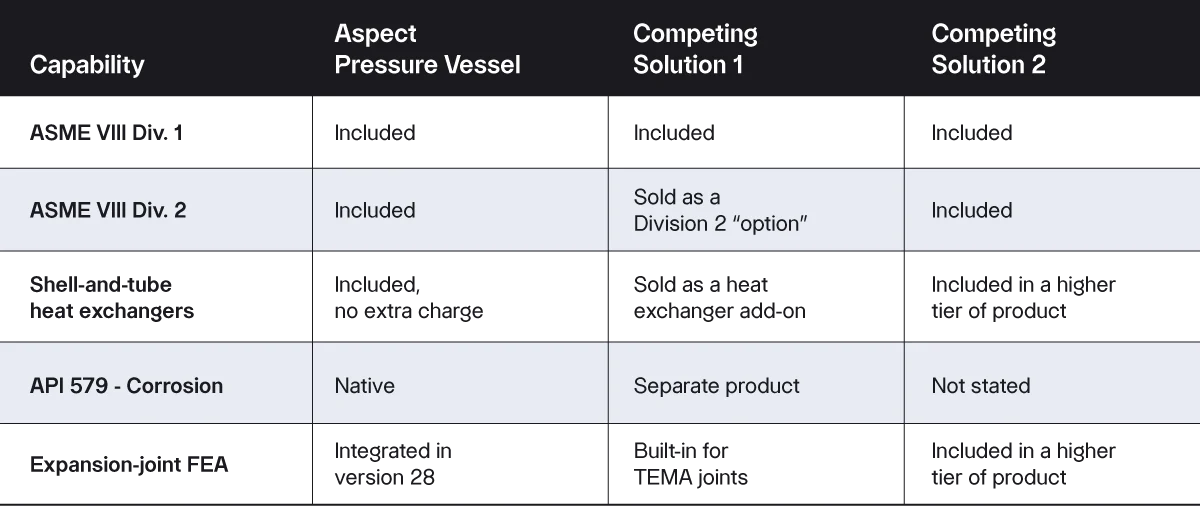
Aspect Pressure Vessel ships as one product covering ASME VIII Div. 1 and Div. 2, PD 5500, EN 13445, EN 1591, TEMA and API 579 corrosion. Heat exchanger design is included at no additional cost. FFS is natively integrated, not a companion application. As of version 28, FEA for expansion joints runs inside the workflow via the GT STRUDL engine — now Aspect Structure — rather than through an export-and-pray round trip.
Compare how the same capabilities are packaged elsewhere, per each vendor's own published materials:
Three unbundled line items are how a "cheaper" quote becomes an expensive one. The engineer who discovers mid-project that fitness-for-service lives in a product the company didn’t buy loses a week, not an afternoon.
2. A global solution with global code coverage
Aspect Pressure Vessel implements ASCE 7, IBC and IS-875 for wind and seismic alongside EN 13445, PD 5500 and AD 2000 while handling settlement, thermal effects and combined load cases in the same model.
That’s not all: when re-rating an existing vessel, you can select a different edition of the ASME design code together with its matching Section II Part D material database through the design code selector. A 1998 vessel gets analyzed under 1998 allowables. Materials must be reselected against the chosen code — a deliberate guardrail, not a gap.
This is quietly the highest-value feature in the product for Owner Operators, because most of the installed base predates whatever edition your desktop defaults to.
3. Vessels don't live alone, and neither should the model
A pressure vessel’s nozzle loads come from piping. Its geometry comes from the 3D model and its anticipated stresses go to the structural team. Every handoff is a chance to transcribe a number incorrectly or to lose data integrity.
Aspect Pressure Vessel maintains a bi-directional interface with Forte 3DWorx (Formerly CADWorx), which can read and write the native vessel file and import piping loads directly from Aspect Pipe Stress (formerly CAESAR II).
Point-solution vendors can integrate with a CAD package. But they can't hand you piping, vessel, tank and structural analysis that share a data model and a support contract.
4. Auditability is a product feature
Aspect Pressure Vessel's quality assurance procedures are aligned to ISO 9001, and the QA Manual ships inside the software under the Help tab, documenting testing against peer-reviewed and published benchmarks. The software also performs ASME VIII QA checks per PTD-3 and PTD-4. Output is structured by MAWP (Maximum Allowable Working Pressure) and component type specifically, so users and inspectors can verify the equations behind each number.
When an authorized inspector questions a calculation, "here is the published benchmark this module was validated against" is a stronger position than "the software said so."
5. Thirty years of continuity, in a market that's consolidating
Aspect Structure version 28 landed with ASME Section VIII 2025 compliance — plus quick-start guided workflows, dynamic dimensions, a 3D view cube, the Vessel Wiki for auto-generated branded reports and single-click 3D PDF output that combines every result into one deliverable. Octave ensures that for every release, critical codes and standards engineers need are always included.
A vessel tool that misses a code cycle isn't inconvenient; it's unusable for new construction.
The outcomes engineers report:
The Evaluation
Don't just trust a solution’s capabilities and pricing on its website. Take these four questions to every vendor on your shortlist:
What does the quote exclude? Price Division 2, heat exchangers and fitness-for-service to ensure you won’t be charged twice.
Can it re-rate a 1998 vessel under 1998 allowables? Ask for a live demonstration or documentation, not a yes.
How do piping loads get in? File import, native interface or manual re-typing?
Where is the validation documentation, and can an inspector read it?
Is it interoperable? Octave’s solutions are interoperable, saving time when transitioning design data or critical information.
Aspect Pressure Vessel answers all four without a follow-up call. Free evaluations are available by request, the documentation is public and training is free through Octave Institute.