Organizations that manage project complexity well are far more likely to succeed. PMI's Pulse of the Profession 2026 found that teams that navigate complexity effectively are five times more likely to deliver a successful project. Yet many companies still struggle to select projects that align with overarching business objectives. Executive leadership grapples with prioritizing initiatives, maximizing resources and supporting optimal efficiency.
Project portfolio management (PPM) is a strategy that evaluates potential projects by their prospective successes and risks, then designates staff, resources and timelines to maximize organizational performance. Your project portfolio might consist of sub-portfolios, programs and individual projects, all of which PPM helps you manage as a unified whole.
Why is project portfolio management important?
Regardless of what your portfolio looks like, PPM keeps you and your team focused on big-picture objectives.
A focus on individual projects increases the risk of raising overhead and leads to reduced ROI. However, by centralizing the management of projects as a portfolio, you can focus efforts on the right projects at the right time.
A centralized approach gives managers a strong foundation to deliver successful projects, and it all starts with a solid PPM process.
The project portfolio management process
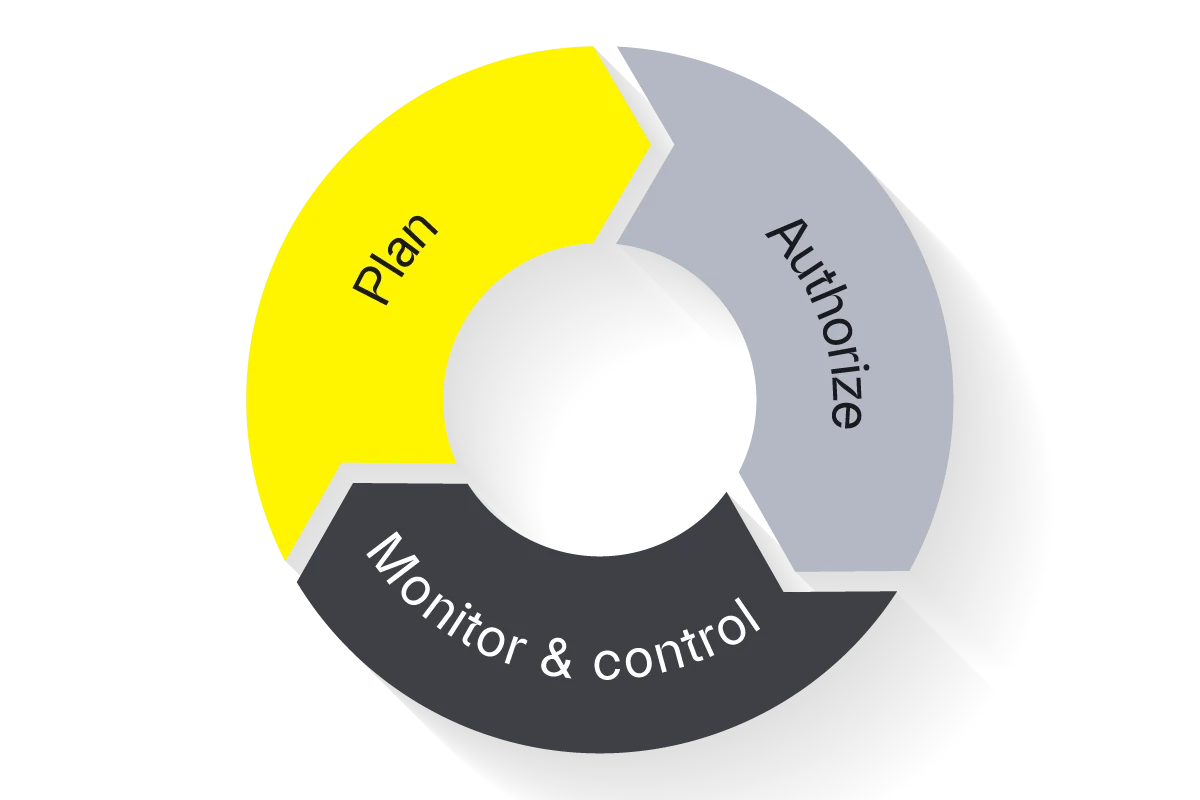
The PPM process is continuous and cyclical. The ongoing practice allows teams to react to sudden changes while mitigating any challenges that might affect overall project success. The process fosters better decision-making to drive achievement of company goals. Though the PPM process is fluid in nature, it runs through three distinct phases.
Portfolio management lifecycle
The Project Management Institute (PMI) defines three phases to the portfolio lifecycle or process: plan, authorize and monitor and control. PMI further classifies these three phases into two groups: the aligning process group and the monitoring and controlling process group.
Here is a high-level look at each group.
Aligning process group
The aligning process group covers how teams select, introduce and classify projects. It also should include up-to-date information on how projects align with strategic goals and current operational rules. This approach allows teams to evaluate individual projects while managing the portfolio as a whole.
This group is most active when an organization refreshes its strategic goals and sets organizational budgets and plans. It could happen annually, quarterly or more frequently, depending on the organization.
Monitoring and controlling process group
The monitoring and controlling process group reviews performance indicators and monitors alignment with strategic objectives. It ensures the whole portfolio performs to predefined metrics set by the organization. Such metrics might include ROI or net present value, for example. The metrics could also monitor performance by category or as an aggregate. Sometimes teams even track individual portfolio components.
Project portfolio management steps
The PPM process consists of five steps that ensure high-level alignment remains both across the portfolio and throughout the PPM lifecycle.
Determine business objectives. To settle on the projects that work for your organization, teams need to be on the same page. One of the most popular ways to create that alignment is to develop a strategy map that outlines exactly what the business objectives are and how team members should prioritize them.
Collect and research information on potential projects. Compile a list of ideas for potential projects and research those ideas. Some sources of inspiration might include ideas from team members, customer feedback or particular regulatory requirements. Then put together some high-level details on those ideas, like potential resource requirements.
Narrow your list and select the best projects. The high-level data from the previous step will give you the tools to choose the projects that best align with your business objectives. Use that data to define a project's differentiators and craft a tentative portfolio that will likely maximize your return while balancing risk.
Validate portfolio feasibility and initiate projects. Next, you'll need to validate the portfolio of projects against their feasibility and available resources. Expand on the high-level data you gathered and create a more realistic picture of the resources necessary to complete a project and what potential setbacks might be. If the project still seems feasible, you can commit resources and move forward.
Manage and monitor the portfolio. Once projects begin, you and your team will need to manage them, keeping an eye on performance and recalibrating as necessary. That might mean handling issues like re-scoping, reallocating resources and regularly reviewing the portfolio as a whole.
Key how-to elements of project portfolio management
While the steps listed above seem simple, organizations often struggle to implement and manage the PPM lifecycle. To begin your PPM journey, you'll need to ask the right questions and arm yourself with the right tools.
Ask the right questions
Though organizations most often consider the association between strategy and projects at the start of the portfolio planning process, it can't be just a one-time consideration. It must undergo a continuous process of evaluation and scrutiny.
Regardless of when that relationship is front-of-mind, asking the right questions will help you to steer each decision in the right direction:
Does the project align with your business objectives?
Is this the most strategic time to begin this project?
How will the project bring value to the organization?
Is the push for the project internal (org-driven) or external (customer-driven)?
How does the project rank in the priority list? Is it urgent or just a nice-to-have?
Does the project have any redundancies? Are there other internal projects trying to achieve similar things? If yes, how can they combine or complement each other?
Can one project serve as a template for another?
Are resources, such as time, budget and skilled labor, available for execution?
Will resources need to be taken from other projects currently in progress? How will this affect them?
Can you manage and achieve stakeholder expectations?
How can you foster clear and consistent communication to ensure stakeholders are aligned throughout planning and execution?
What are the key performance indicators (KPIs) that you will measure the project's success against? What are the KPIs that will indicate the project's impact on the portfolio? Are different measures needed at the portfolio level?
These questions paired with a project portfolio management approach will help your organization adopt a more well-rounded view toward projects.
Other project portfolio management tools and techniques
Aside from asking critical questions, there are other PPM techniques that provide a structured way to evaluate, select and prioritize aspects of the aligning process group in the portfolio management lifecycle.
Here is a quick introduction to five such PPM tools and techniques:
Cost/benefit analysis: A ratio used to evaluate the risk versus reward in any project. The lower the cost and higher the benefit, the more likely a project is to succeed.
Decision tree analysis: A qualitative analysis tool that evaluates scenarios shaped by multiple subjective factors. PPM tools set up hypothetical scenarios and provide a basis for evaluating possible outcomes.
Scoring model: An analytical technique that bridges quantitative and qualitative factors of a decision with weights and scores. The technique creates a rational basis to prioritize projects with the highest scores.
Estimated commercial value (ECV): ECV incorporates risk into a formula similar to Net Present Value (NPV) to evaluate the probabilities of success for commercial and technical projects.
Objectives matrix: This method splits the high-level organizational strategy into multiple business objectives and assigns scores for projects as they align to each objective. The matrix allows for sub-goals to be factored in to create a nuanced way to evaluate projects against objectives.
Choose the right PPM tool
Just as important to the PPM process as asking the right questions and using the right techniques is selecting an excellent PPM tool.
The PPM tool you select should not only provide you with greater visibility into your portfolio, but also enable the people and processes involved. In this way, the software solution allows you to select projects that align with your company's objectives, supports the long- and short-term budgeting processes and helps your employees to better manage complexity. The right PPM tool will also ensure that projects match priorities and provide a feedback loop once projects are started.
Some of the must-have attributes and functions for PPM software include:
strategic planning
capital planning
opportunity management
project development
resource management
portfolio analysis and reporting
stage gates and automated workflows
The data that comes from these functions gives you real-time, objective insights into what's happening across projects. It allows you to make informed decisions by evaluating "what-if" scenarios like:
What would happen if a particular project is cancelled?
How would a three-week delay in this project affect resources for another project?
What would be the impact of sharing a resource across projects?
How would increasing this year's budget by 10% impact next year's roadmap?
A robust PPM tool with an intuitive user interface offers a quick way to evaluate these questions and more.
For asset-intensive industries that operate huge, complex facilities (e.g., power and utilities, oil and gas, transportation), much of their project portfolios and the funding for them revolve around ensuring optimal asset performance over time. AIP is the practice of using data generated by your assets to inform long-term decision making and investment planning. The benefits of effective AIP are improved asset performance, reduced operating costs and enhanced maintenance planning. Tied to your PPM approach, the AIP process draws on a complete view of portfolio data. You can optimize the possible scenarios and combinations of projects to determine the best investment plan for years to come. Because of this, your portfolio manager gains a full picture of asset requirements and can take action to ensure peak asset planning and care, resulting in enhanced performance.
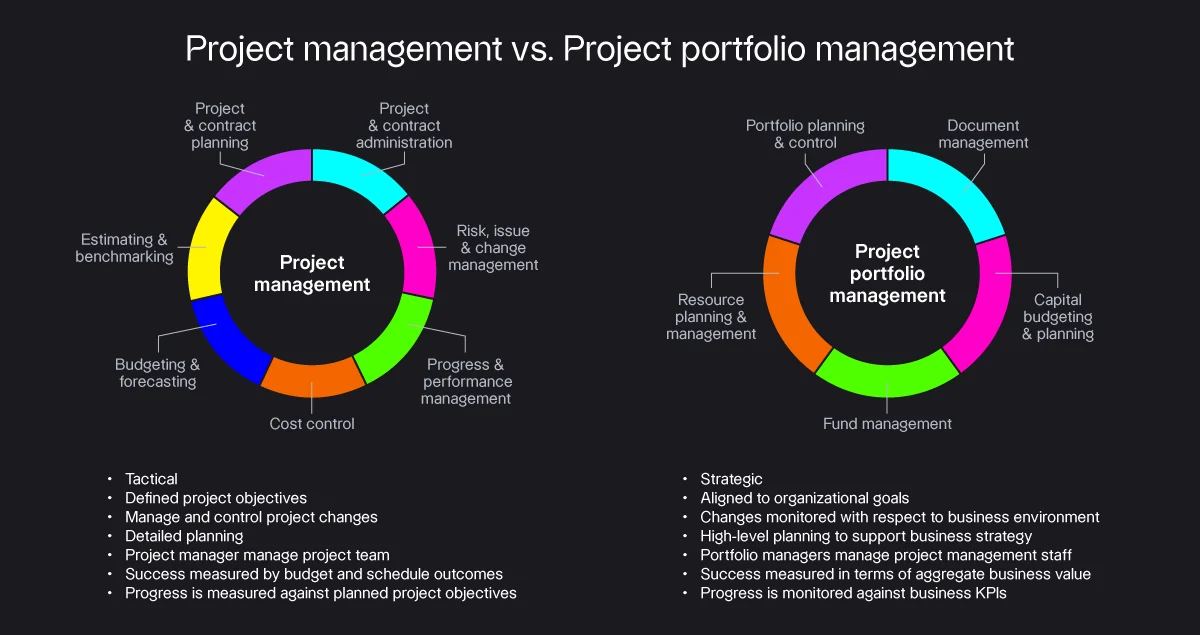
Project portfolio management vs. project management
Though it may seem like PPM and project management are interchangeable, there are some important differences. Project management, and thus project managers, focus on "doing projects right." PPM and portfolio managers, on the other hand, focus on "doing the right projects."
To expand on this, PPM concerns itself with the big picture and how all of an organization's projects collectively work toward meeting strategic and ROI goals. For example, project management might focus on ensuring the right people are on the right tasks for a particular project. PPM, though, looks at how any particular project fits into a portfolio and ensures the portfolio is performing well.
The role of the project portfolio manager
The primary role of a project portfolio manager is to merge the company's business strategy with project implementation. Unlike a project manager, a portfolio manager is focused on project selection rather than task breakdown. In other words, a project portfolio manager is concerned about the "what" and "which," while a project manager takes care of the "how."
At its core, the role of the portfolio manager is to understand the organization's constraints that impact the project. Examples include budget, time, infrastructure and people. These constraints, along with the organization's strategic objectives, will guide the portfolio manager in their selection of projects. Every project they select will require an investment of time, money and other limited resources. A portfolio manager's effectiveness depends on their ability to collaborate with the organization and individual project teams.
The responsibilities of a project portfolio manager include:
project request management
resource allocation and management
risk management
identifying and reducing inefficiencies
collaborating with senior stakeholders
change management
tracking business ROI of projects
Benefits of PPM
Good PPM practices add depth and maturity to organizations. They drive a harmonized approach to managing projects at scale, delivering both quantitative and qualitative benefits that sharpen the conditions for consistent project success.
Organizations that navigate complexity and manage their portfolios well fail less often and waste less money, benefits that also indirectly result in improved customer satisfaction.
PPM brings with it an array of other benefits. Decision-making can more easily focus on facts over subjective factors, particularly when an organization is working toward something big, like adjusting to impending regulatory changes. PPM allows you to step back and think about how the necessary adjustments will impact the risk and reward of projects, and whether it changes the overall calculus for inclusion in the portfolio:
Do the changes impact how the project aligns with the organizational goals?
Do the regulations have a long- or short-term impact? When do they begin? Will the regulations be in effect for the foreseeable future, or do they seem to be temporary?
How will the new regulations impact the project's workflow and timeline?
What follow-up needs will this create, such as training or change management?
What costs are associated with implementing the necessary adjustments and does that impact the business case?
Can PPM help analyze the decision and mitigate risks?
PPM also facilitates a collaborative rather than a competitive environment within the organization, which actually improves resource efficiency. If internal departments don't have to compete for IT engineers, for example, in order to accomplish the same goal, it frees up resources to focus on other objectives, such as improving customer service or ROI.
Project portfolio management best practices
PPM has many sub-disciplines and its implementation can differ from one organization to another. While some prioritize resource management, others prefer continuous visibility into projects.
Here is our list of best practices to guide you through your PPM journey:
Understand the business strategy: As PPM is all about aligning projects with a business strategy, it's important to first understand that strategy and how it changes. For example, if the primary objective changes from increasing productivity in specific global markets to focusing on product innovation, PPM priorities must shift as well.
Identify the right set of projects: Often, companies mistake activity with forward progress. A wrong project executed flawlessly is still a failure, as it does not move the company forward in the strategic direction.
Establish a Project Management Office (PMO): Creating a PMO to handle PPM activities formalizes the processes and equips staff. It reflects the support of senior executives in the PPM approach.
Create standards for project evaluation: As projects get tossed around for evaluation, it's essential to create common criteria and a checklist of metrics to score them against. This is the only way to make an apples-to-apples comparison.
Formulate a risk management strategy: Portfolio managers can reduce risk by performing a risk-versus-reward analysis using PPM models, such as cost-benefit analysis and ECV, and investing in projects that yield maximum returns.
Formulate a change management strategy: Change is the only constant. Markets change, technologies evolve and customers revise requirements. A change management strategy anticipates all of these. When carefully selected, metrics can trigger the notifications that drive appropriate and timely responses to unforeseen changes.
Use a PPM tool: Software simplifies the complexities of PPM and helps integrate tactical project controls with strategic project selection. Tools like Octave Sequence Enterprise (formerly EcoSys) project performance software help portfolio managers make the most of PPM and easily monitor portfolio KPIs.
Project portfolio management software
When executed well, project portfolio management can be essential to the successful growth of any company or organization. It establishes a structure for evaluating and selecting a portfolio of projects, fluidly monitoring them through dynamic change and guiding them with right-sized controls to completion. Software tools vastly simplify the complexity of the process, particularly when that process is a collaborative effort.
When choosing the right PPM software for your business, choose a vendor with deep experience in the project industry. With this knowledge, they'll be able to understand your business goals and help you reach them. Your vendor ideally functions as a true partner, helping prepare you and your team as you enter a new way of operating. Although adopting a new tool brings change, implementation of PPM software usually comes when organizations reach a crossroads as their success almost becomes too much to handle. The changes that come with PPM software alleviate project stress and support future growth.
Evolving maturity
Most organizations still have room to grow in their portfolio management maturity. Wellingtone's 2026 State of Project Management report found that 44% of organizations are somewhat or very dissatisfied with their current level of project management maturity. While most organizations are familiar with and even practice PPM, not everyone uses it to its full potential.
For example, are resources managed well? Are the PPM processes continuous and adaptable? Is there a portfolio-centric culture in the organization? Are there effective tools that bolster the process? Performing a gap analysis will help reveal the steps needed to take this maturity model further.
To be effective, your PPM should have consistent, reliable collaboration from the entire organization, from the C-suite down. To have a positive impact on profitability, it should provide transparency into key metrics and financial aspects of projects. The objective should be to avoid competition and organizational siloing. PPM will put everyone on a path toward collaboration to attain the strategic goals of the organization.
Ready to optimize your project portfolio? Contact us to get started.