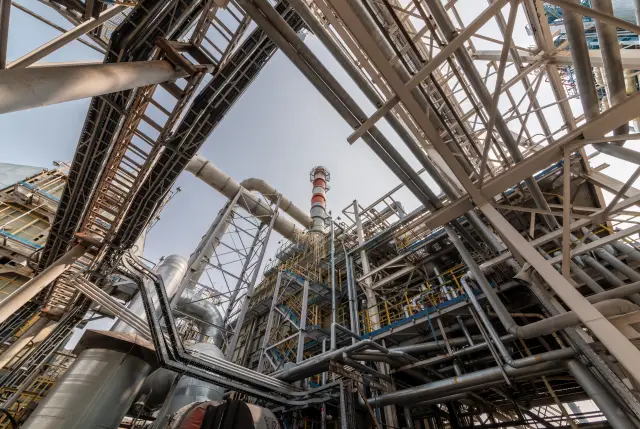
BIA specializes in engineering, procurement and construction management (EPCM) in the food and biomass industries with a focus on the sugar industry. Active across the Middle East and Northern Africa regions, the company works with its clients to design, build and maintain industrial facilities.
Identifying goals
The company recently worked on a sugar refinery project in the MENA (Middle East and North Africa) Region. For this project, the company had to design and layout the equipment and piping for the facility and ensure that the construction was done according to the design and specifications provided by the client. Split between the mechanical and electrical teams, 15 engineers and designers were involved in the project.
BIA needed a solution that would allow them to model the piping and equipment in 3D, analyze the piping and equipment connections to avoid over-stress and create isometric drawings of the piping referencing connected equipment. BIA also wanted to provide 2D and 3D views of their designs to keep everyone on the project team aligned and to track progress easily.
Overcoming challenges
“Building large Sugar Refineries involves a high degree of work complexity. Established work practices require our staff to follow each step manually, which takes time and increases costs. We needed a software solution that could help us automate our whole process. This will help reduce costs and time taken by the project team, contributing to overall improved efficiency at the plant site,” said Mechanical and Piping Engineers at BIA.
The main challenge BIA met during project execution was the project’s overall size. A sugar refinery is not like a usual food production factory: it is a complex, large- scale project that requires workers, managers, designers and engineers from different countries speaking different languages to work efficiently together. BIA had to design a refinery with a capacity of 3,000 tons per day. This refinery was the largest project undertaken by BIA to date, so having multiple software packages with different formats and data requirements would add another layer of unnecessary complexity.
With Octave’s Forte 3DWorx Design Suite, 80 percent of the project could be completed in a single package. This made collaboration between designers much easier, as no file conversion was necessary, meaning everyone always had an up-to-date view of the model. Third-party tools were used to design complex mechanical equipment, but because of the high-fidelity interoperability available with Forte 3DWorx, integrating mechanical designs from other parties was also possible.
Realizing results
BIA chose to use Octave solutions, Forte 3DWorx , and Aspect Pipe Stress for the sugar refinery project.
The company used Aspect Pipe Stress to execute the stress analysis on the piping and equipment. The bidirectional links between Forte 3DWorx and Aspect Pipe Stress enabled BIA to import models quickly, reducing the risk of manual transcription errors while improving accuracy and efficiency.
Forte 3DWorx provided a comprehensive set of modeling tools for different disciplines, allowing users to create highly detailed models in less time through its easy-to-use but powerful modeling and modification tools. The user-friendly Catalog and Specification Editor made creating and maintaining the piping specifications straightforward. In addition, the automatic isometric generation enabled by the Forte Isogen engine provided with Forte 3DWorx greatly benefited such a large project.
Accurate isometrics that can be trusted and do not need manual correction are vital in ensuring that fabrication and construction are trouble-free.
The result was a complete 3D model that met all BIA’s needs, from pipe routing to mechanical and electrical connection points. Creating a single model with all relevant information integrated into one solution enabled BIA to make changes as needed throughout the project lifecycle quickly.
To speed adoption, BIA received training in Aspect Pipe Stress. This helped engineers learn about the software and its features, including dynamic as well as static calculations. After eight days of training, they could use the software effectively and complete their calculations without any external support from Octave.