Part 2: Building industrial competence - creating world-class connected ecosystems
Brent Kedzierski
7 minute read
Welcome to the second installment of our four-part blog series, "building industrial competence." We'll explore two development frameworks and how they align with Octave solutions to deliver world-class connected ecosystems. Our goal is to introduce these frameworks and demonstrate how they drive organizational alignment, integration and performance during the deployment of asset lifecycle intelligence technologies.
The connectivity problem: siloed and tech-centric approaches
In today's rapidly evolving technological landscape, connected solutions have the potential to reshape industries and open new levels of productivity and human development. However, many organizations find themselves disconnected internally, struggling to advance their connected ecosystem efforts. The number of failed or slowed initiatives highlights the need for a more thoughtful and strategic approach to organizational alignment and solution design.
The common challenges that organizations face include the lack of organizational alignment and the inability to deploy iterative and integrative design strategies. This results in a variety of disjointed and low-risk, low-value experiments across multiple autonomous areas. At the same time, you will see teams working toward similar problems using divergent goals, approaches and redundant efforts.
This lack of alignment leads to internal disconnection, confusion and silos rather than streams of united effort. Most importantly, disjointed approaches hinder the progress cycle by promoting missed opportunities for synergy, resulting in watered-down transformation efforts. A strategic and aligned approach is essential to overcome these challenges.
The connectivity solution: applying organizational development models with connected technologies
To address the challenges that organizations face in implementing connected solutions, a strategic and holistic approach and effective change management are required. One effective solution is to apply organizational development models alongside connected technologies. By adopting proven design frameworks, organizations can align their efforts, establish clear goals and foster a collaborative approach to implementation.
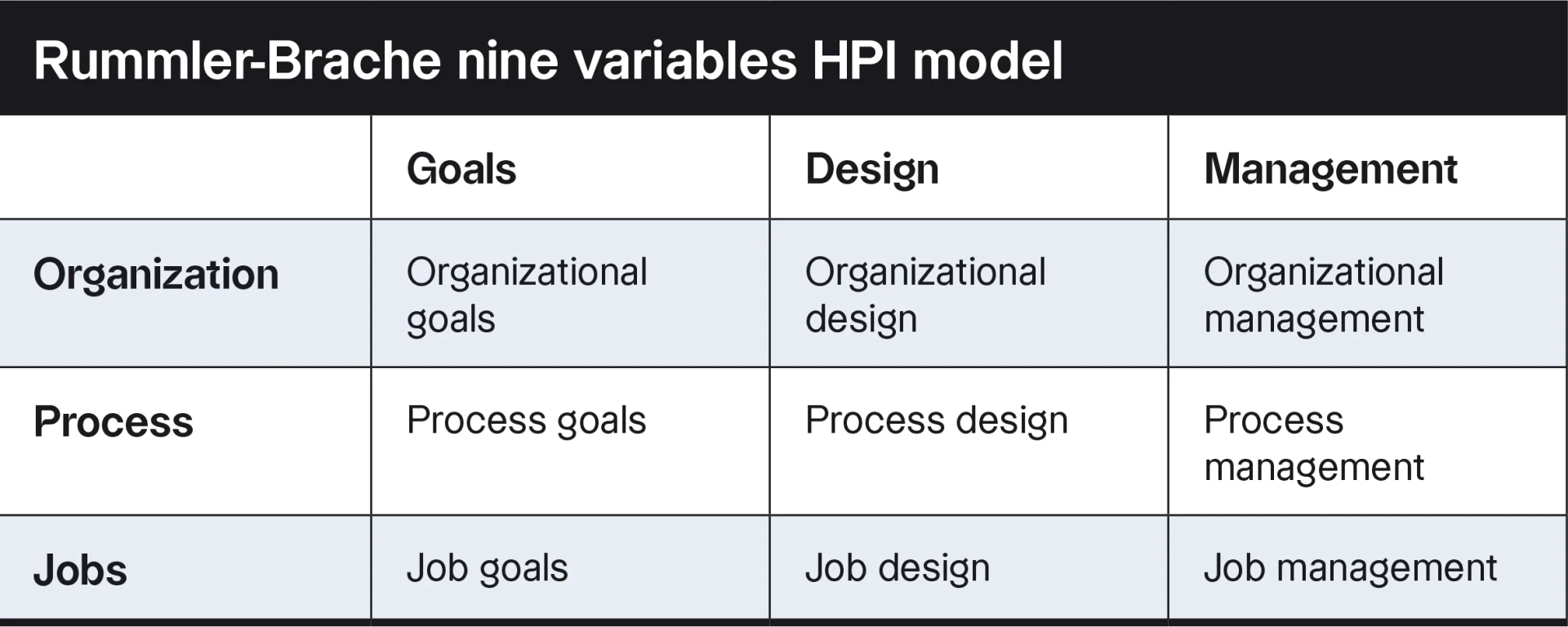
At the connected plant level, the Rummler-Brache framework (see Table 1) serves as a comprehensive guide for aligning and integrating connected plant ecosystems. This framework highlights essential interdependencies, interactions and alignment across organizational levels.
By using the Rummler-Brache framework in conjunction with Octave solutions, organizations can align connected plant technologies with their goals, designs and management at all levels of the plant.
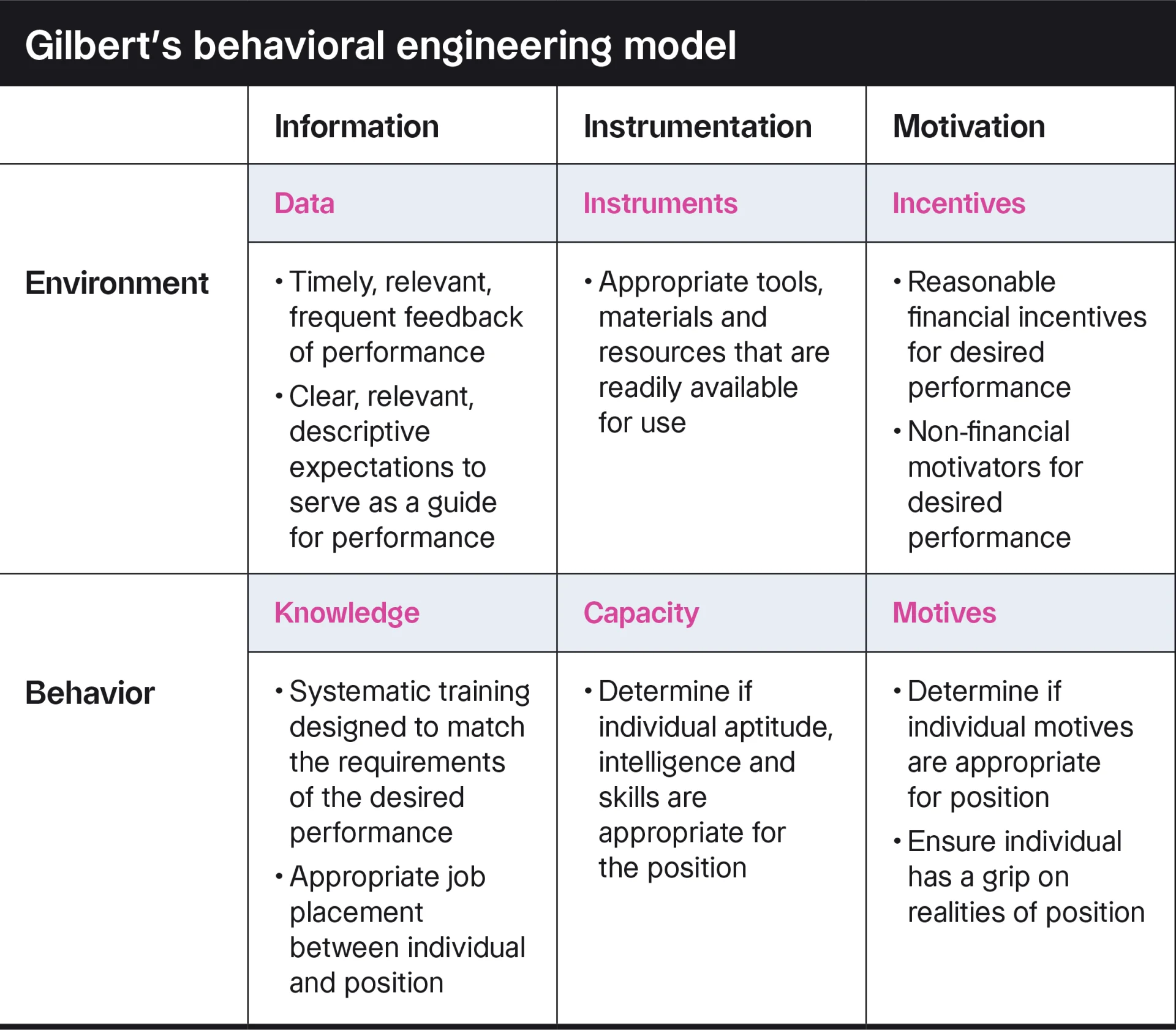
Similarly, Gilbert's behavior engineering model (BEM) (see Table 2) plays a pivotal role in the design of connected worker solutions. The BEM ensures that connected worker solutions address the six dimensions of work that drive human behavior and job performance. Octave solutions offer comprehensive human performance support that aligns with Gilbert's model, empowering workers, enhancing their ability to excel in their roles and improving their work experience.
Designing connected plant ecosystems
The Rummler-Brache framework serves as a comprehensive guide for aligning and integrating connected plant ecosystems. It highlights essential interdependencies, interactions and alignment across organizational levels. By embracing this model, organizations can maximize the potential capability of their organization, core processes and workforce.
Let's explore how Octave solutions align with the Rummler-Brache model, driving the creation of connected plant ecosystems:
Organizational level:Octave InConcert Core (formerly HxGN SDx) acts as the foundation for organizational data collection and management, enabling real-time analytics and visualization. InConcert Core supports data-driven decision making and workflow efficiency across the asset and enhances overall performance.
Process level:Octave Tempo Control System Effectiveness (formerly PAS PlantState Integrity) ensures process and asset integrity through continuous monitoring of critical processes, systems, equipment and operations. It provides accurate information, instrumentation and resources to optimize control systems and instill confidence in workers.
Job performer level:Octave Tempo Operations Management (formerly j5 Operations Management Solutions) and Octave Tempo Operating Procedures (formerly AcceleratorKMS) complement the process and organizational level solutions, supporting individual and team performance. Tempo Operations Management products facilitate efficient day-to-day operation, process support and real-time incident and near-miss management. Tempo Operating Procedures acts as a centralized knowledge management system, delivering personalized on-demand, learning experiences and job-related content tailored to workers' specific needs.
Alignment and integration across the three levels is essential for maximizing the potential of the workforce and enhancing operational safety, efficiency and learning. The Rummler-Brache model offers a pragmatic and actionable framework that organizations can adopt to optimize their connected plant ecosystems and maximize operational performance.
Designing connected worker ecosystems
Once organizational alignment is achieved, the focus shifts to designing connected worker solutions. This is where Thomas F. Gilbert's behavior engineering model (BEM) comes into play. Gilbert's BEM model provides a framework for understanding the environmental and individual factors that drive human behavior and performance.
Gilbert's model was originally developed in the 1970s, but its principles and practices are still widely applicable today. Many contemporary performance improvement models and methodologies are based on Gilbert's work.
This section provides examples of how Octave offers comprehensive solutions that optimize worker performance across each dimension of the behavior engineering model:
Performance expectations and feedback: With Octave Tempo Boundary Analytics (formerly PAS InBound), operators receive clear task instructions and performance standards in real-time. Tasks guide them and they receive immediate feedback on their progress, ensuring that they meet standards. This feedback loop fosters a culture of continuous improvement and enables workers to consistently perform at their best.
Tools, instrumentation, data and resources:InConcert Core provides a comprehensive digital twin that allows workers to visualize the entire system and make informed decisions. Tempo Automation Integrity (formerly PAS Automation Integrity) and the Tempo Operations Management provide the necessary instrumentation and data for efficient job performance. This empowers workers with the information and tools they need to excel in their roles.
Anatomy of work [1]: Octave solutions aim to eliminate traditional workplace frustrations and incentivize workers to perform at their peak. InConcert Core creates a collaborative and informed work environment in which workers can contribute to optimizing their asset performance. Tempo Boundary Management engages operators with a user-friendly interface, clear expectations and real-time feedback, fostering motivation and a sense of ownership in their tasks. Octave Tempo Management of Change (formerly j5 Management of Change) establishes a standardized and organized work environment that promotes efficiency and quality.
Skill development and knowledge access:Octave Tempo Work Instructions (formerly j5 Work Instructions) and Tempo Operator Rounds and Routine Duties (formerly j5 Operator Rounds and Routine Duties) provide step-by-step guidance, improving workers' skills and ensuring consistency in task execution. Octave Tempo Alarm Management (formerly PAS AlarmManagement) delivers real-time alarm information, enabling workers to make informed decisions. Tempo Operating Procedures acts as a centralized knowledge management system, delivering personalized and engaging learning experiences.
Human capacity to perform (quality, productivity and safety): Octave solutions use the power of automation to enhance human capacity. Octave Tempo Shift Handover (formerly j5 Shift Handover) and Octave Tempo Incident Management (formerly j5 Incident Management) reduce the workload on workers, enabling them to focus on more challenging and critical tasks or learn new skills. InConcert Core provides real-time analytics and visualization, equipping workers to optimize asset performance and ensure top-quartile quality. By freeing time and providing critical path information, these solutions elevate the capacity of workers to perform both cognitive and physical tasks as they also develop their skills in working in collaboration with advanced technologies.
Human motivation to perform: Octave solutions help create a highly motivated workforce. Tempo Boundary Analytics offers a user-friendly interface that engages and motivates operators, giving them a sense of purpose and direction in their tasks. Tempo Incident Management promotes a culture of continuous improvement, encouraging workers to prioritize safety and quality in their work. Tempo Operating Procedures delivers personalized learning experiences, fostering motivation and thirst for knowledge among workers. These solutions tap into workers' intrinsic motivation, leading to higher workforce engagement.
Conclusion
In today's rapidly evolving technological landscape, the potential for connected solutions to reshape industries and open new levels of organizational and human performance is clear. Many large organizations struggle to implement connected ecosystems effectively, facing challenges such as organizational misalignment and a lack of clear implementation strategies. The failure of many connected solutions highlights the pressing need for a more strategic and aligned implementation approach. Especially if organizations intend to keep pace with opportunity.
By adopting a strategic approach that applies organizational development models, such as the Rummler-Brache framework and Gilbert's BEM and implementing Octave solutions, organizations can overcome the challenges posed by siloed and tech-centric approaches in connected ecosystem design. These frameworks and technologies work together to deliver the promises of alignment and connectivity. Promises in terms of assets, processes and workers working in harmonious ways to drive operational efficiency, open new and greater levels of industrial competence and promote a new era of worker skill development and improved job experience.
In the next part of our blog series, we will explore what a competence framework for implementing connected plant ecosystems might look like, using the concepts introduced in the first two blog series articles. Stay tuned for more insights and practical guidance on building competence to succeed in the era of connected industries.