EPC succeeds on India’s first solar thermal power plant
Siemens Group, a leading innovator of leading-edge technology-enabled solutions, has 17 companies in India employing 18,000 peeople, operates 21 manufacturing plants and has ties with 500 channel partners.
Identifying goals
The Siemens Energy division at Vadodara, Gujarat, India, provides turbine, compressors and induced-draft fan solutions for power plants.
One Siemens project was for Godavari Green Energy Limited, a 50 MW facility in Nokh, Jaisalmer, Rajasthan. This was India’s first solar thermal power plant. The client was Godavari Power and Ispat Ltd., and Siemens’ scope included engineering and supply of the turbine, generator, auxiliaries, and steam piping.
Overcoming challenges
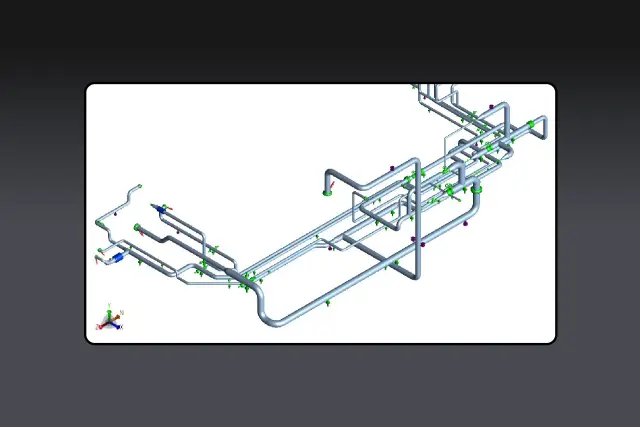
The pipe ranged from 15 Nominal Bore (NB) to 250 NB in diameter providing systems with auxiliary, sealing and leak-off steam at temperatures of up to 400°C. The project also encompassed the lube and high-pressure oil systems, the condensate and vacuum pump piping.
The configuration of the turbine facility made the overall piping arrangement very cumbersome and rigid. With the anchor point in the center, the thermal expansion on the smaller-diameter turbine nozzle is high, meaning allowable loads on the nozzle are far less.
Siemens had only six months to release stress reports and hanger specifications, and there was no database available for valves, specialty items, turbine or structures. The project also required coordination with a U.S.-based consultant in key areas, adding to the challenges.
Aspect Nuclear Pipe Stress (formerly CAESAR II) was chosen to perform this high-profile project.
Without Aspect Nuclear Pipe Stress’ capabilities, the project would have been delayed by nearly two months, and the level of confidence of the execution team and the client would have suffered. The input of the load data and stress analysis would have taken much more time if performed manually. Manual calculation of expansion loop arrangement would have been a time-consuming activity with the results being less accurate.
“Using Aspect Pipe Stress capabilities, we are able to reduce the time and cost while achieving a higher accuracy level,” said Medhesh Nirmal, manager on the project.
Siemens was able to design the complete sealing and leak-off system in a single model file and analyze the system as a whole in one step.
“We saved nearly 200 work-hours with the Aspect Pipe Stress Nozzle Limit Check module, where we identified allowable loads against all nozzles to ensure optimization,” Nirmal said.
Siemens leveraged the software’s optimization wizard to perform multiple iterations during analysis and achieve the desired results. This saved the company another 300 workhours and reduced the schedule by one month. Aspect Pipe Stress helped improve productivity and accuracy in many other areas during the project.
Realizing results
With Aspect Pipe Stress, Siemens was able to provide the client a wide range of deliverables, including the stress isometrics, the code compliance and stress summary, the load case report with restraint summary, the hanger datasheet and bills of material, the nozzle check report and others.
Siemens squeezed the time frame and met the expectations of all involved, including civil engineering, equipment vendor and procurement.
“Most of all, the customer was satisfied, with Siemens Turbine landing five out of six thermal solar projects,” Nirmal added.