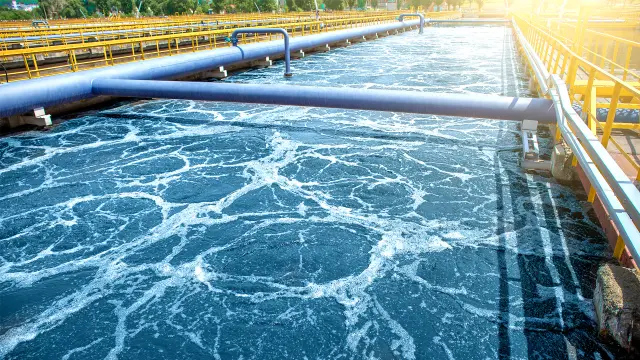
RAK Wastewater Agency (RAKWA) manages all wastewater collection and treatment for the emirate of Ras Al Khaimah. It’s a complex, high-stakes operation — and the margin for error is slim.
The emirate covers an area of about 2,478 km2, has a population of some 345,000 people and is home to thriving industries including manufacturing, cement, ceramics and leisure and tourism. It also produces 12 million cubic metres of wastewater annually.
To serve the emirate, RAKWA manages the operation and maintenance of 4 sewage treatment plants, in addition to 330 km of sewage networks and 13 lifting stations across the emirate. RAKWA is also responsible for the construction and management of the public wastewater collection and treatment infrastructure, monitoring the trade effluent of commercial and industrial activities while regulating private wastewater systems.
The organization, which is one of four agencies that forms the Public Service Department of the Ras Al Khaimah government, is also responsible for managing the reuse of treated wastewater as part of its strategic objective to enhance the sustainability of Ras Al Khaimah, which has a bold ambition to reuse 100% of its wastewater.
The challenges
Water management, collection and treatment is a complex and intensive task which draws on a vast amount of heavy infrastructure and assets—all of which need to be efficiently maintained to ensure optimal performance. With limited rainfall and high demand for water, RAKWA was under pressure to treat as much wastewater as possible in the interest of sustainability.
One of RAKWA’s key challenges was to manage and maintain its assets, ensuring high-quality maintenance across all of its operations, including capital assets such as pumps, motors, and pipes. With so many assets to track, the operations and maintenance (O&M) department struggled to maintain clear oversight of where to direct maintenance resources. This led to a reactive maintenance approach rather than a proactive approach that could pre-empt issues before they occurred. This approach led to higher maintenance costs, increased downtime and reduced efficiency.
To sharpen operations, RAKWA brought in specialists to overhaul the maintenance function — automating workflows and moving from manual processes to digital tools. Walid Abdulrehman Mohammed joined as O&M department manager in early 2017. He quickly identified the need for a unified system to monitor and manage RAKWA’s assets — one that could shift maintenance from reactive to proactive.
“The biggest challenge we used to have was the efficient utilisation of our workforce and also the accuracy of the operational data which actually affects your decision- making processes,” he said. “The data available about the assets was not accurate and not sufficient to conduct a proper assessment.”
After assessing several enterprise asset management (EAM) solutions from different vendors, the O&M department decided to implement Attune EAM. They chose the system over solutions from rival vendors due to its suitability for utilities, and especially wastewater operations.
The solution was implemented by Intertec, a technology partner in the UAE, in mid-2018 and took about 6 months to complete. The implementation meant logging each asset individually — pumps, pipes and motors — along with key details like age and lifecycle. In total, 3,300 assets across 330 km of sewerage network, 13 pumping/lifting stations and 4 treatment plants were logged in the system. With access to all this information, RAKWA used Attune EAM to automate all asset maintenance. Daily schedules told the O&M team exactly which assets to check, repair, maintain or replace — before problems arose.
Impact
One year after implementing Attune EAM, Mohammed and his team have no doubts about the immense benefits of the software and its transformative impact, both on the O&M division, and the entire organization.
RAKWA now uses Attune EAM to help manage assets across its operations, from the collection network to the maintenance and operation of wastewater treatment plants. “All of these assets under each facility are managed through Attune EAM, from the workholder level up to the asset evaluation, performance evaluation, and store inventory and spare part management,” Mohammed said. “We have automated the whole process. We have removed all the paperwork and manual processes.”
The team now schedules maintenance far more rigorously than the old manual system ever allowed.
The O&M team has also seen a clear reduction in the percentage of emergency-based work orders versus total work orders. Emergency work orders, where an asset is at risk of failing or threatens to disrupt services, have declined to about 0.4 to 0.45%, compared with almost 1% in 2018.
This is a significant drop, with major positive reliability and efficiency gains for RAKWA.
RAKWA experienced further savings by using its workforce far more efficiently. Fewer hours wasted on reactive maintenance meant that more time could be spent on more efficient and effective preventive maintenance, creating a positive feedback loop.
Attune EAM is also helping RAKWA’s O&M team at a more strategic level. With access to accurate data, the team can make better decisions, especially when deciding on the timing of large maintenance projects. “Our decisions are made on more accurate data and more real-time data being captured,” Mohammed said. In this way, the system has enabled RAKWA to improve the way it governs and manages the entire maintenance operation, which has in turn reduced human error. The O&M division estimates that the amount of corrective maintenance and related work orders has decreased by 17%.
Mohammed estimates that Attune EAM has reduced costs across the entire operation by at least 3%. Those savings go back into capacity — treating and reusing more water every year. “We have a maintenance plan for all our assets, and each has a certain task and frequency to be implemented, so the system allowed us to make the plan and its execution far more efficient,” Mohammed said.
Given that the volume of water that RAKWA collects and treats is growing every year, these savings will also grow—ultimately contributing to RAKWA’s aim of returning 100% of the water it collects for re-use.
Attune EAM is also helping RAKWA to reduce how much it costs to collect and treat water. It currently costs AED 0.65 to treat each cubic metre of water, while it was 0.67 two years ago. RAKWA aims to achieve a 30% reduction in its operational cost for collection and treatment of one cubic meter of water.
Looking to the future
While the gains from Attune EAM have already been significant, Mohammed and his team are keen to keep building on their current success. The team plans to expand the EAM program and roll out additional digital tools — building toward its goal of becoming a fully “digital water” operation.
One key part of this will be the introduction of internet of things (IoT) systems, along with the software to monitor and manage them. As part of this plan, the O&M division hopes to implement an Enterprise Resource Planning (ERP) solution to accurately measure past performance and forecast activities. “We are trying to install sensors to critical assets that can then interlink with Attune EAM directly, so that we will get instantaneous data, as well as building a data pool that will have medium and long term value,” Mohammed said.
This would give the O&M team sharper insight into operational performance — improving everything from resource allocation to performance reporting.
“Ultimately, it’s about improving water sustainability in Ras Al Khaimah. We’re proud of what we’ve achieved so far and are excited by the prospect of implementing more technologies to fulfil our goals in the near future,” Mohammed said.