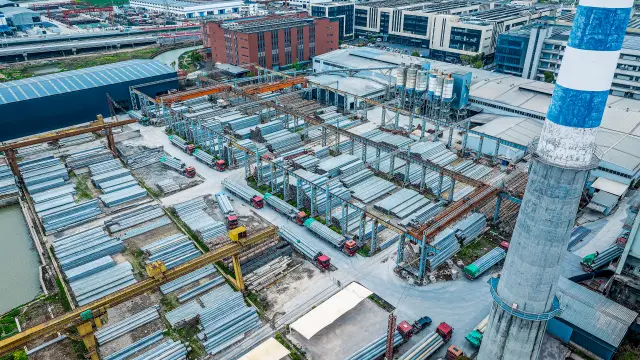
A top global EPC firm performed a three-month Octave Loop Materials pilot project on a module yard site in the Canadian Oil Sands. The purpose of this pilot was to perform a live, side-by-side comparison of Loop Material Readiness and the project’s legacy materials management solution. Octave’s solution offered real-time Material Readiness data in a collaborative platform with RFID-enabled mobile technology; the legacy solution was paper-based and did not have a mobile component. Loop Material Readiness served as a bolt-on solution, providing material visibility in real time in an automated, mobile and graphical interface on both tablets and a desktop server.
The project team, comprised of Loop Material Readiness and unbiased EPC personnel, performed time studies for Loop Material Readiness mobile transactions alongside the manual, paper-based processes that were the EPC firm’s status quo. The study focused on the following transaction types with anticipated improvements by implementing Loop Material Readiness:
Material Receipt: Anticipated gains in efficiency by eliminating paperwork
Request, Pick and Issue Processes: Anticipated gains in efficiency by eliminating paperwork, improving visibility and process control
Material Location Tracking (Track and Trace): Anticipated gains in improved material visibility, reduction in material location times and reduction of temporarily lost materials
The intent of this field comparison was to quantify the time savings and efficiency gains achieved with an auto-ID enabled mobile solution for field transactions to build a business case for an enterprise-level adoption of Loop Material Readiness across all the EPC firm’s projects, globally.
Study methodology and assumptions
The Loop Material Readiness team and the EPC field team worked on-site for the duration of the pilot. To establish baseline measurements, the Octave-EPC team first shadowed module yard personnel performing activities on-site, recording exact process activity sequences and associated time demands. The team spent additional time interviewing personnel to gather subjective data around process pain points. Any process activities not directly observed by the Octave-EPC team were replicated in mock trials, with the observed time demands rolled into the expected total process times. With few exceptions, all input data used in ROI results and estimates were empirically derived.
It was assumed that a full Loop Material Readiness deployment beyond the pilot project would include upstream tagging at the supplier location for pipe spools and steel. To incorporate that assumption into the pilot testing, the Octave-EPC team travelled to supplier locations to tag materials. Receiving time savings data assumed that time demands associated with applying RFID tags or barcodes would be absorbed by the supplier.
The Octave-EPC team and mod yard team agreed that ROI measurements should focus on project activities in which Loop Material Readiness would be leveraged during an actual implementation at the mod yard, specifically receiving, picking, issuing and material storage location maintenance support.
Mod yard observations and pain points
The following were recorded and used as a baseline for future measurements of efficiency gains:
Delay in Material Receiving Report (MRR) paperwork submission to office and delay in actual data entry
Delay in pick tickets returned to office for filing
Difficulty locating pipe spools
Lack of materials visibility post-pick
Implementation results
Receiving
To improve process comparison, time savings percentages excluded the time between MRR paperwork completion in the field and the time the MRR is entered into the legacy system. This delay was significantly larger in scale than the activity process times (hours versus minutes).
However, this delay does impact material visibility. The EPC team members observed an average eight-hour delay from the time an MRR was completed in the field to the time the MRR was delivered to the materials management office.
The EPC team observed a further four-hour delay before the MRR data was input into the legacy system.
Overall result: When comparing the entire receiving cycle time, from MRR creation in the field to final update of the legacy system, Loop Material Readiness reduced the MRR cycle time by 12 hours. This efficiency gain was made possible by using RFID tags on pipe spools loaded onto trailers upstream at the fabricator. Receipt of the materials required only a scan of the tag with a mobile tablet.
Result by percentage breakdown
MRR Process Time Savings - 47%: Loop Material Readiness-enabled receiving reduced the total receiving activity time by 47% when considering MRR scenarios that did not contain OS&D, Direct Transfer of Material (DTO), or Rework from data entry errors. The time reduction is driven primarily by the ability to scan pre-tagged/pre-barcoded materials to check against the shipment packing list, and the instantaneous transfer of MRR data into Loop Material Readiness and the legacy system upon tablet sync. These two process improvements eliminate the need for manual data entry of MRR information into the legacy system, as well as the manual checking of handwritten material IDs against a paper-based shipment packing list.
MRR Process Time Savings - 59%*: Loop Material Readiness further reduced receiving process times when including the time demands associated with overages, shortages and damages (OS&Ds), direct transfer of material (hot material) and re-work scenarios. Specifically, the EPC team observed a 93% reduction in time demand associated with the OS&D management process. Loop Material Readiness automatically generated OS&Ds based on user-definable logic, eliminating the need to manually create OS&D reports in the legacy system. When required, Loop Material Readiness enabled users to capture photographs with the tablet and automatically associate the images to both the damaged material and OS&D record. This eliminated the need to capture, upload and organize OS&D photos in a separate file directory, external to the legacy system.
When direct turnover to the workface was required for hot material, Loop Material Readiness reduced the time by 80%. Loop Material Readiness supported immediate issue of received materials without the need to sync to the server, while the legacy system processes required the manual creation of a pick/issue ticket.
Material location, pick and issue
Result by percentage breakdown
To improve process comparison, time savings percentages excluded the time between MRR paperwork completion in the field and the time the MRR is entered into the legacy system. This delay was significantly larger in scale than the activity process times (hours versus minutes).
Material Location Time Savings - 63%: The time required to locate materials was reduced by 63% when using a combination of GPS coordinates and RFID tags. Although outliers were removed from the datasets to allow for better process comparison, there were instances observed by the Octave-EPC team of picking crews unable to find materials for multiple hours without Loop Material Readiness technology. Those work hour costs are higher, considering that multiple workers were searching for the materials simultaneously.
It is important to note that this study was conducted at a relatively small, well-organized and well-run modular facility with an experienced materials management crew. Despite these advantages, the GPS and RFID functionality within Loop Material Readiness still contributed to a significant improvement in material location efficiency. It’s reasonable to expect further efficiency improvements when implementing Loop Material Readiness on larger, more complex projects.
Pick and Issue Time Savings - 46%: Using the same approach as the MRR process analysis, time savings percentages excluded the time between pick ticket paperwork completion in the field and the time the signed pick ticket is returned to the warehouse for filing.
This delay is significantly larger in scale than the activity process times (hours versus minutes). While this delay did not affect material visibility under the non-Loop Material Readiness enabled process, it did increase the risk of documentation loss. This risk was virtually eliminated by using Loop Material Readiness-enabled devices in the field to perform picks and issues, giving materials management staff immediate visibility into the specific state of materials as they moved through picking and issuing processes in Loop Material Readiness.
Material visibility
The EPC firm’s legacy materials management application did not track materials beyond the pick and issue stage. Using Loop Material Readiness, we confirmed the feasibility of tracking picked and issued materials through installation. To demonstrate this concept, status logic was defined so that any materials located by sweep in front of a module were automatically updated to “at workface.” Once the RFID tag was removed and read in a disassociation zone, the status was automatically updated to “installed.” In addition to issuing the pick list from the legacy system, Loop Material Readiness tracked three additional material statuses, post-pick:
Picked: Material was picked
At workface: Material was staged
Installed: RFID tag was collected and disassociated
Loop Material Readiness is an award-winning Material Readiness® application designed specifically for construction. By digitizing and automating the manual, paper-based data collection of construction’s past, Loop Material Readiness provides real-time visibility to all stakeholders throughout your supply chain. Employing a combination of web-based server software, mobile devices and smart RFID tags and barcode labels, Loop Material Readiness removes impediments to productivity and ensures workers have the materials they need to spend more time on tools.