With more than 20,000 employees in 50 countires, Mott MacDonald is a major provider of engineering and design, management and technical consulting and project and construction management services to oil, gas and petrochemical businesses worldwide.
Identifying goals
Spiecapag Pty Ltd. selected Mott MacDonald to provide engineering for 445 km of onshore pipelines for gas production and processing facilities in Papua New Guinea operated by Esso Highlands Limited, a subsidiary of Exxon Mobil Corporation.
The pipelines transfer gas to the facility outside the capital city of Port Moresby for liquification and export to major LNG customers in Asia. Following Australian standards, the project encompassed all equipment and infrastructure for collecting and conveying the gas and condensate.
Mott MacDonald’s OGP Andheri office in India was the project lead.
Overcoming challenges
The pipelines ranged from DN20 to DN850 and involved pressures of 12500 kPag to 56100 kPag and temperatures of -46 degrees C to 80 degrees C. These pipelines cross rugged terrain with geohazards such as surface fault crossings and seismic activity. Engineers had to address stress from the effects of wind, earthquake, soil properties and diverse operating conditions.
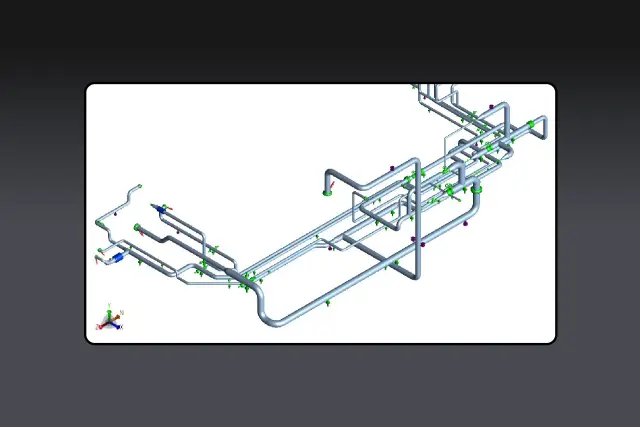
The project required multiple revisions in stress models and fast turnaround on rework, and Mott MacDonald benefitted from the proven flexibility of Aspect Pipe Stress and its ability to address these types of challenges. It analyzed the effect of pipelines according to ASME B31.4 and associated piping according to ASME B31.3 in the same model, reducing the number of models and saving time and associated costs.
Realizing results
Aspect Pipe Stress allowed Mott MacDonald to create a site-specific earthquake spectrum and perform dynamic analysis to develop optimum loading conditions and analyze the possible vibration modes. With the project’s diverse soil conditions, it used Aspect Pipe Stress to simulate the above ground and buried pipe behavior and stresses for the location of virtual anchors. This saved in material, cost and time for the EPC contractor.
It used Isogen for Aspect Pipe Stress module to generate isometric drawings internally for design inputs such as types of supports and piping layout changes. This provided greater accuracy, reducing errors, work-hours and costs.
As equipment, pig traps are typically outside the purview of the pipe stress engineer. While the civil team was designing the foundation of the pig traps, the engineers analyzed the composition of the foundation design loads and modeled the pig traps as pipe elements. This expedited foundation design, saving additional time.
With the flexibility of Aspect Pipe Stress’ modeling and analysis capabilities, Mott MacDonald was able to sail through this challenging project while addressing these continuous changes, while also achieving milestone incentives and generating additional revenue for the organization.