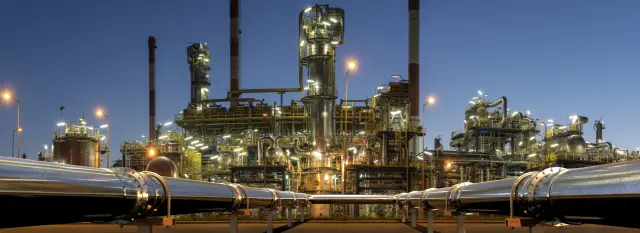
Since its establishment in 1965, Engineers India Limited (EIL) has emerged as Asia’s leading design, engineering and turnkey contracting company for energy and other industrial projects. The company provides planning, design, engineering and construction for client projects in petroleum refining, petrochemicals, pipelines, offshore oil and gas, onshore oil and gas terminals and storage infrastructure for mining and metallurgy.
Identifying goals
For its Green Fuel and Emission Control (GFEC) project, Hindustan Petroleum Corporation Ltd. selected EIL to provide mechanical design of the continuous catalyst regeneration (CCR) platforming reactor using the Universal Oil Products (UOP) catalyst reforming process. The four reactors, mounted one above the other, reach an overall height of 44,900 mm and a diameter of 1850 mm, with a fabricated weight of 87 MT.
Overcoming challenges
The stacked CCR reactor design configuration required significant structural support, making the project one of the most complex designs ever undertaken by the Pressure Vessel Department of EIL. The company had to obtain structural inputs and actual piping load for realistic conditions and consider many practical considerations such as available plate thickness while avoiding an excessive number of plate thicknesses that would add to the complexity and cost during fabrication. EIL performed the protection and controls (P&C) for the various sets of conditions that equipment would face and analyzed the final design for 15 different conditions based upon these evaluations.
The project’s large scale and complexities also required an iterative design process to understand the behavior of the equipment plus multidisciplinary coordination. A project of this scale and complexity would normally require many work-hours, something EIL had to avoid due to the client’s tight schedule.
Realizing results
By using Aspect Pressure Vessel, EIL was able to simplify this highly complex project. The engineering and final design of the reactor required internal and external pressure calculations, wind and seismic design, nozzle details, center of gravity calculation, body flange details, skirt and anchor bolt analysis, detailed weight and capacity calculation, wind deflection analysis and maximum allowable working pressure (MAWP) calculations. The Pressure Vessel Department sent the data to EIL’s Engineering Technology Development Department for FEA Analysis. This confirmed the accuracy of the Aspect Pressure Vessel calculations for the project’s design.
Completing this complex design within the tight schedule would not have been possible without Aspect Pressure Vessel.
“Aspect Pressure Vessel proved to be a very useful tool for the complex design’s iterative process, helping us deliver an optimum design solution that saved 14 tons or 14% of low alloy steel metallurgy on the project, an achievement that would not otherwise be possible,” added senior engineer, Sourabh Agarwal. “It always feels good when an internationally recognized company appreciates your work, but the best feeling is when your work is apprized at a scale that brings accolades to your company.”