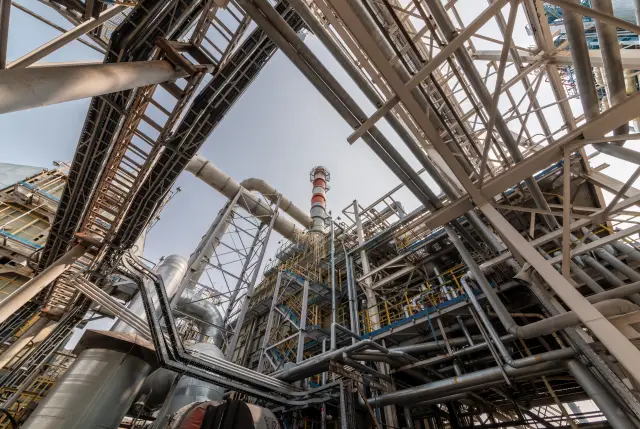
ENEOS Kiire Terminal Corporation was established in 1967 by Japan’s largest oil company and operates a world-class crude oil terminal. Its activities include crude oil storage, transfer, and blending. Kiire Terminal has 57 tanks containing up to 7,350,000 m3 of crude oil reserves, enabling ENEOS to respond to unforeseen political, economic, and social events.
The challenge
Many of the Kiire Terminal's veteran operators were approaching retirement. Management was concerned their expertise should be retained within the company and transferred to the new operations personnel with technology that would appeal to the younger generation.
Management wanted to achieve a rigorous Plan-Do-Check-Act (PDCA) cycle of continuous innovation and needed systems to support this cycle of learning and incremental improvement.
A comprehensive, integrated operations management system was needed to improve systems such as event logging, shift handover, work instructions, inspection rounds, near misses, abnormal events, DCS limit changes, asset maintenance, and reports.
It saw the need to improve data visibility and communication between operations teams and other business units.
Finally, it wanted to unlock the potential benefits of the Tempo Operations Management connector for Aveva™ PI System™ by automating reporting and event management.
How Tempo Operations Management solved the problem
Kiire Terminal implemented these Tempo Operations Management solutions:
Tempo Shift Handover (formerly j5 Shift Handover) produces reports for operators and supervisors with relevant data, events and instructions for each unit and area of the operation from Tempo Operations Logbook (formerly j5 Operations Logbook), Tempo Operations Management, and connectors. This ensures that a consistent, visible and accountable process is followed.
Tempo Work Instructions (formerly j5 Work Instructions) enable planners to schedule ad hoc and recurring tasks for the operations team members. Tasks are marked off as complete and summarized in Tempo Shift Handover.
Tempo Operator Rounds and Routine Duties (formerly j5 Operator Rounds and Routine Duties) facilitates the recording of plant data from the field. Operator rounds are designed in Tempo Operations Management in the control room, uploaded to a mobile device, completed by the field operators and then synchronized. Round information is readily available for analysis and reports.
Tempo Standing Orders (formerly j5 Standing Orders) allows for the controlled dissemination of important communications within the facility.
Tempo Incident Management (formerly j5 Incident Management) provides a platform on which all near misses and incidents occurring on the plant are recorded, investigated, analyzed and reported.
Tempo Operations Management monitors connector database tags for anomalies. Tempo Operations Logbook entries are automatically created and followed up on by operators.
Custom Tempo Operations Management applications and associated reports are delivered to monitor tank levels, manage operating limit changes, report asset-related issues and generate work issues.
Benefits of Tempo Operations Management
Tempo Operations Management makes important shift, inspection round, personnel, safety, maintenance and process data visible to the Kiire Terminal team. This fosters greater understanding, coordination, knowledge transfer, communication and improves decision-making.
Role-based workflows (for example, for Tempo Shift Handover, Tempo Incident Management and Tempo Work Instructions) improve efficiency, safety and follow-through. Tempo Operations Management facilitates a Plan-Do-Check-Act cycle of continuous innovation by bringing consistency to work processes and making the right information available. As requirements evolve, adding and adapting new Tempo Operations Management solutions is easy.
Tempo Operations Management saves time preparing reports and extracting data. Accuracy is improved with Tempo Operations Management connectors to external databases. Tempo Operations Management provides a consistent, intuitive user interface, unifying and simplifying operations management.
The simplicity, comprehensiveness and unity of the Tempo Operations Management architecture also make them reliable and cost-effective to maintain.