Blue Projects is a global multidisciplinary engineering and project management company with offices in 26 locations and projects delivered in more than 50 countries. The company provides end-to- end services across the project lifecycle, from conceptual design to commissioning and covering civil, process, packaging, utilities and automation disciplines.
Blue Projects Utilities (BPU), the company’s utilities team, focuses on industrial mechanical utilities, specializing in refrigeration, heating and reticulation systems for process fluids and gases. BPU delivers projects as EPC or EPCM contracts, primarily for the food and beverage industry, while also supporting specialized refrigeration solutions in the mining sector.
Unlike vendors tied to specific Original Equipment Manufacturers (OEMs), BPU is fully independent. This independence enables the team to recommend the most suitable technical solution for each client, ensuring designs that prioritize efficiency, flexibility and long-term value.
Identifying goals
The BPU team was working on a project to deliver a turnkey refrigeration system for a new greenfield brewery in Mozambique.
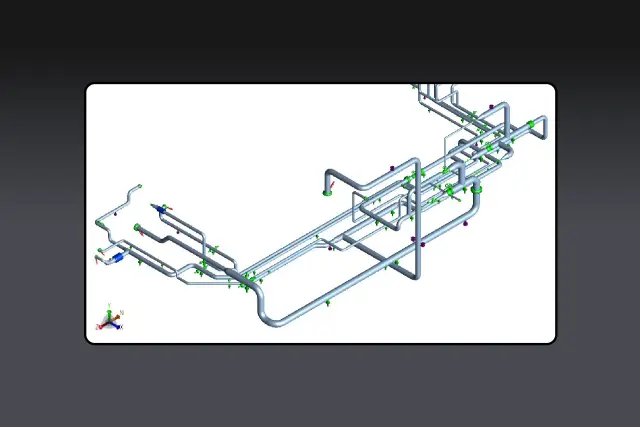
One critical part of the project was the ammonia hot gas line — the section of the piping that carries refrigerant from the compressors to the condensers.
For aesthetic reasons, the client wanted all the condensers to be placed in a straight line. This requirement created a challenge: the main header pipe had to be designed to match this layout while keeping the mechanical loads on the compressor and condenser nozzles within safe limits set by the OEMs.
At the same time, the design had to comply with international piping codes, requiring accurate stress analysis to account for fluid groups and temperatures used in refrigeration systems. Evaluating bending and thermal expansion stresses was essential to ensure safe operation. In the past, BPU carried out these analyses manually, which was a slow and complex process that made large projects difficult to manage.
To meet these requirements and modernize their workflow, the team adopted Octave Aspect Pipe Stress with support from Octave’s local partner, Chempute. This solution is an industry-leading pipe stress analysis software that enables engineers to model, evaluate and document the structural integrity of piping systems under static and dynamic loads according to dozens of international codes.
Overcoming challenges
Engineers received training through Chempute to get up to speed quickly, and the standard package was sufficient for their needs without extra customization. The team integrated the software directly into its existing design process.
The team used Aspect Pipe Stress to model code compliance for reticulation systems. A typical workflow begins with conceptual pipe routing, which is then analyzed in Aspect Pipe Stress to define support requirements and identify any changes needed to reduce stresses within agreed-upon tolerances. The tool is widely applied to heated or cooled systems, where accurate evaluation of bending and thermal expansion stresses is critical.
With the shared software license, each engineer can carry out modeling and evaluations independently, allowing the utilities team to take on more work. Aspect Pipe Stress also enables support load data to be shared with structural partners early in detailed design, improving collaboration and reducing rework over the course of the project.
Realizing results
Implementing Aspect Pipe Stress into Blue Projects’ design process has brought significant benefits, including a formal, calculated model and the ability to share results consistently across the team and with partners. Jaco Kirstein, Technical Director at Blue Projects, reflects on how Aspect Pipe Stress has strengthened collaboration with equipment manufacturers: “One of the biggest benefits of using Aspect Pipe Stress on this project was the ability to partner with the OEMs, allowing them to better understand the forces their equipment nozzle would experience during the actual installation.”
Aspect Pipe Stress proved easy-to-use, allowing engineers to adapt quickly. The software effectively handled bending and thermal expansion stresses and aligned with the ASME and EN design codes BPU typically uses. These factors made stress analysis faster and reduced the need for later adjustments.
For the Mozambican brewery project, Aspect Pipe Stress enabled the team to meet the client’s request for aligned condensers while staying within OEM limits for nozzle loads. The refrigeration system was delivered on time and designed to balance efficiency and future scalability.
Reflecting on the long-term outcome, Jaco explains, “For this project, we were able to not only meet the client’s needs, but to do so with energy efficiency incorporated into the solution. The plant can accommodate a ramp-up program over multiple years, meaning it remains efficient across an extensive load range.”
Moving forward
Looking ahead, Blue Projects plans to continue using Aspect Pipe Stress as a standard part of its design process for piping systems. The software has become essential for ensuring code compliance, optimizing support requirements and sharing accurate force data with OEM and structural partners.
The brewery plant in Mozambique was also designed with future scalability in mind. It’s designed to be doubled in capacity during the upcoming phases, ensuring the investment remains efficient over a wide load range.
For Blue Projects, Chempute will remain a key partner. Chempute hosts training, provides license updates and offers professional, responsive support that helps engineers apply Aspect Pipe Stress effectively on projects and ensures projects run smoothly and meet requirements.