Most projects hit major roadblocks before they cross the finish line. According to PMI's Pulse of the Profession 2026, roughly one-third of complex projects fail to deliver their intended benefits, nearly twice the 13% failure rate for projects overall.
Why do projects perform poorly? Factors such as ineffective project management and even downright incompetence contribute to poor performance. But one factor that project managers most often cite as the reason for delays and failures is scope creep.
This guide covers what scope creep is, why it derails even well-planned projects and how you can prevent it.
Scope creep refers to the uncontrolled or unapproved changes to the list of project requirements, goals, deliverables and features that the stakeholders originally agreed on.
To fully understand what scope creep is, though, it's helpful to first have a solid comprehension of scope itself. Scope is the list of features and deliverables in a project that all of a project's stakeholders, including customers, project teams and senior leadership, agree to before the project begins. A documented and approved scope definition helps a project manager break things down into specific work items.
Project managers usually discuss scope in conjunction with the resources (time, money and personnel) available. For instance, one phase of a construction project can have the following as its scope: lay the foundation in three months using six workers and two supervisors with a budget of $10,000.
So in this example, scope creep might come about because the client wants to use a different, more expensive type of concrete than what they originally agreed to. Or scope creep might occur because, during the course of a construction project, the client may want to erect additional pillars or build more walls.
PMI research has found that more than half of projects experience scope creep. While it's common across small and large projects, in industries such as construction, engineering, oil and gas, utilities and logistics, its impact is highly pronounced.
Why does scope creep matter?
Scope creep matters because its consequences compound quickly, from budget overruns to stakeholder rifts that can damage the core business or brand.
Here are the key consequences of unchecked scope creep.
It throws off project timelines
As scope expands, projects get delayed. There's a reason why stakeholders agree to a certain timeline at the start of a project, and the cumulative add-on of seemingly small features impacts the original schedule.
Take the example of the Berlin Brandenburg Airport (BER). The airport was in the planning stage for almost 15 years, and construction finally started in 2006. It was slated to open in 2012, but a series of issues affected the project, delaying the opening until 2020. The schedule for the airport's construction, which experts frequently cite as a case of project mismanagement, kept slipping due to scope creep.
It can lower morale
Most scope increases start off small. During an informal conversation, a client may mention that a particular feature, not included currently in the project scope, would be a big value-add. A project team member may then agree to implement the feature, assuming that the effort involved is minimal (a tendency referred to as optimism bias) or in an attempt to please the customer.
But as projects stumble with delays and cost overruns, this significantly affects the morale of all parties involved, particularly project team members and customers.
In the case of the BER, consider the number of people who worked on the project for years. It's impractical to hold interest and sustain energy levels in a project with criticism mounting from all sides, pressure to deliver and unreasonable expectations imposed.
It wastes time and resources, which impacts your bottom line
The BER project cost an estimated €7.9 billion, 50% more than its initial approved budget. Even today, with the project finally complete, there are talks about expanding the airport to meet increased demand, which could cost another €2.3 billion.
This isn't surprising given that the project got delayed by almost nine years. It's ironic that in most cases, scope creep starts out as "Can you do just a few more things inside the same budget and schedule?" but in reality ends up stretching both the budget and schedule.
What causes scope creep?
To avoid the chaos and disaster that scope creep can create, we need to start by pinning down the factors that cause scope creep in the first place. Here are some of the main causes.
Not clearly defining the project's scope
It may seem obvious to begin a project by defining its scope, but it's surprising how often we come across projects that are ambiguous in nature. Some projects begin with fanfare and a grand mission statement, but stakeholders try figuring out an action plan as they go.
The National Programme for IT (NPfIT) for the U.K.'s National Health Service (NHS) is one such case. Its objective was to build a comprehensive system to manage the healthcare services of the country. However, many things went wrong with the project. In their rush to get to the finish line, politicians and program managers expedited the procurement process, drawing up the contractual paperwork even before the scope was clear.
As a result, the project came to be known as one of the "worst and most expensive contracting fiascos" in the country's public sector history.
Lack of alignment between stakeholders
Multiple stakeholders with diverse and conflicting objectives make alignment challenging, to say the least.
Consider a project with two stakeholders, one whose goal is regulatory compliance and the other whose goal is to add product features that increase customer satisfaction. This is a recipe for disaster. In trying to meet both their needs, you would most likely end up satisfying neither of them.
You can observe this trend in the public sector, where there are far too many stakeholders (federal, state and local authorities) with different agendas, each with their own influence over funding decisions. The planning stage languishes for years, and the projects end up becoming expensive, or worse, shelved.
Failing to force-rank priorities
One common cause of scope creep is the inability of teams to prioritize the project's requirements. The client may want a ton of features, but realistically, teams can't implement every request due to constraints.
Hence, you need to create a hierarchy of priorities to be able to plan work in a way that addresses mission-critical items first. Lack of clarity at this stage means that down the road, you could end up spending more resources on items that aren't mission critical and neglecting essential items.
Some organizations unfortunately have a culture where it's difficult to say no and engage in tough conversations, which leads to agreeing to everything but failing later.
Establishing estimates in a bubble
If only a handful of people at the top are estimating resources, it's likely that those estimates aren't realistic. People who carry out most of the day-to-day work of a project have the best insight into what's realistic, but the key is to make sure different departments aren't operating in silos.
For instance, the business team may understand what the customer wants, but the execution team has a better sense of the complexity and feasibility of implementation. Poor communication between the two groups leads to inaccurate estimates.
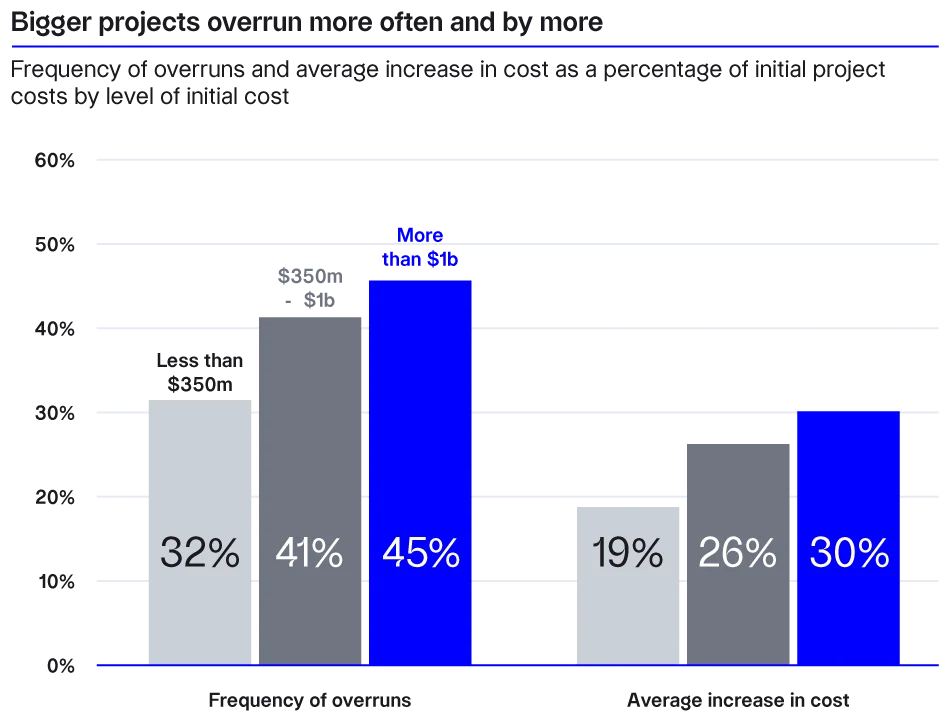
And the more complex a project is, the more this poor communication compounds. This is especially true for megaprojects, where it gets difficult to account for the multitude of viewpoints from people across geographies, organizations, departments and hierarchies. A Grattan Institute report on Australian transport infrastructure found that almost half of projects with a budget of $1 billion or more overran their initial costs, by 30% on average. As the report put it, the extra amount spent on some megaprojects was the size of a megaproject itself.
Neglecting efforts to involve the client regularly
Some projects start off with a well-defined scope and schedule. But over the course of the project, many factors change. The best way to remain plugged in to these changes is to keep your ears to the ground. This means meeting with the client regularly, since the client is in the best position to quickly determine whether the project scope and the assumptions made at the start of the project continue to be relevant.
Just think of all the metro rail construction projects that typically run over schedule by decades. In the initial plan, the team may have prioritized the build-out of certain routes that were expected to reduce traffic congestion in the city. However, over months or years, this could change. For example, a new airport at the city outskirts could result in a pressing demand to set up airport connections. Frequent client conversations are the most effective way to catch these triggers early on.
Not planning for changes and new requests
Planning for new requests may seem counterintuitive, but it is not the same as scope creep.
Scope creep means that the scope changes without formal approval. It's naive to believe that project requirements will remain rigid, especially for long-term projects. In the metro rail construction project example we discussed above, the scope needs to change to account for the demand to add airport connections. But if there's no clear change management strategy outlining how the team will handle change requests, who will make decisions, how to realign resources and how to assess overall impact on cost and schedule, it can lead to scope creep.
QA takes longer than expected
Testing and QA phases are a common source of hidden scope creep.
Teams that skip thorough test planning discover issues at the last minute and end up returning to the board with scope revisions.
How do you manage scope creep?
PMI's Pulse of the Profession research shows a strong correlation between the maturity of an organization and its project outcomes. Typically, the more mature an organization is, the less likely it is that its projects experience scope creep. Higher-performing organizations consistently show lower rates of scope creep and lose less budget when a project fails.
As the research shows, there's a definite value and ROI in establishing mature project management practices that can avoid scope creep. These practices make a measurable difference.
1. Understand the project's goals and scope
Due to pressure from clients and shareholders, teams often want to just get on with project execution. But this is a risky course of action.
It's important not to rush through the scope definition process. Instead, engage in fact-based conversations and feasibility studies. The initial goal should be to fully understand of the scope.
In addition to conducting feasibility studies, convert high-level requirements into a granular work-breakdown structure. This helps translate a client's needs into action items and helps iron out any ambiguities.
2. Determine the best communication channels
Create a culture that encourages people to give the bad news early on. Open communication helps prevent people from operating in their own bubble, without considering feedback from the rest of the stakeholders.
Specifically, establish which channels you'll use and how often you'll communicate with each stakeholder or department. For local teams, a daily morning quick face-to-face status update might be sufficient. But to communicate with departments, vendors and teams in other locations, you might need to set up longer video or audio conference calls on a weekly basis to track status and understand the risks and concerns involved in meeting your goals.
3. Set a clear schedule
Most projects have an approximate final target date and a rough schedule. But when the schedule isn't granular enough to show incremental deadlines for each step of the project, it's difficult to plan for change requests. And when the idea of estimating the resources needed for a change request appears complex, people end up choosing the alternative and sneaking those changes through backdoor channels.
The solution here is to map high-level requirements to low-level tasks, with a clear indication of how much time each task takes. This makes it easier to identify precisely which tasks the proposed change will affect, how many new tasks need to be added and how much more time and resources a scope change would take.
4. Document and communicate requirements
Documentation is one of the most underrated activities in terms of its effectiveness. But it ensures that everyone is on the same page, not just today but months or years later, when people's memories can fail them.
In large and complex projects, documenting your requirements can be a lifesaver. For example, during the course of a construction project that spans years, it's unreasonable to expect people to remember specifications such as dimensions, layout plans and configurations. It's best to record these requirements and communicate them to all stakeholders. Then if there's any confusion, the scope can be revisited and potentially revised even before the project begins.
5. Don't let perfectionism get in the way
Many times, scope creep starts with good intentions. You might have team members who are keen to prove themselves and believe it's easy to squeeze in a couple more functionalities in a rollout. But they tend to get carried away with a narrow, short-term focus and lose the ability to see the big picture.
Many of the features may not add a lot of value and are just nice to have, and that's probably why they weren't included in the scope in the first place. It's best to avoid this perfectionism, as it puts the project schedule and budget under stress.
6. Plan for change management
The best way to handle change in projects is to plan for it. A solid change management plan supports several factors, such as:
Accountability: Accountability and transparency in accounting for changes help ensure everyone is on the same page and knows how and why stakeholders make decisions.
Fast approvals: Quick turnaround times on approvals mean teams can pivot quickly and keep things on schedule.
What-if planning: A comprehensive understanding of how changes will play out and impact the rest of the project means you can adjust accordingly.
One of the first steps in creating a plan for change management entails forming a committee of decision makers who come from a wide cross-section of teams. This is the group that should review every request through the lens of a what-if analysis. Before signing off on any changes, they should ask questions like: What is the impact on cost and schedule? Is the change feasible? Is there sufficient cause to include the change at this point in time?
The key to completing any of these steps successfully comes down to ensuring that your processes are connected, not operating in silos. This holistic approach will help you better forecast the impact of changes on costs and schedule, and these critical insights help determine next steps, such as financial requests and reallocation of resources.
The most important step: use the right tools
Most mature organizations know that you can't avoid change. While they invest in research and engage in conversations to define a reasonable scope at the start, they also leave room for changes by implementing solid project control, change and risk management processes.
Most importantly, such organizations don't rely just on intuition or individuals to conduct the what-if analysis. Rather, they have clear, holistic workflows made possible by tools and systems that help manage changes with speed and reliability.
To help your team operate in this framework of connected systems, Octave Sequence Enterprise (formerly EcoSys) offers a single software solution for project management and project controls. With Sequence Enterprise, your team can link change management to budgeting and forecasting, create visual workflows to handle reviews and approvals, understand how project changes drive portfolio and contract changes and more.
To see how Octave Sequence Enterprise can help your team beat scope creep with connected change and risk management, contact us.