The NATO Innovation Continuum is a multifaceted exercise with the intention of taking concepts to combat readiness, turning ideas into impact for NATO forces. There are four stages to Innovation Continuum — SPARK, IGNITE, GLOW and SHINE — which act as NATO’s fast lane for emerging tech: scoping, testing and deploying solutions that meet today’s battlefield challenges and provide advantages and increased security for NATO countries.
SHINE 2025 showcased how NATO can use AI, autonomy and other emerging and disruptive technologies (EDTs) to counter real threats, from undersea sabotage to drifting mines to glide bombs.
Explore Octave’s geospatial solutions for defence
Technology demos
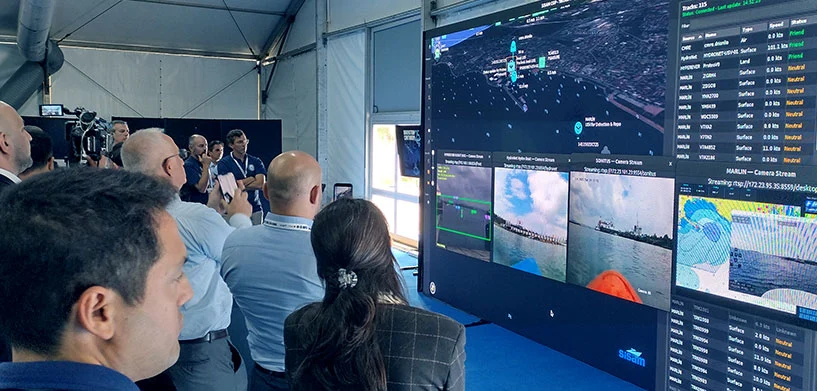
Octave took part in two technology demos, providing its Octave Alto (formerly Luciad) SDK, with which Sefine Shipyard’s Unmanned Systems Research Center (SISAM) built a common operating picture (COP) used to show situational awareness for the demonstrations.
COP in action
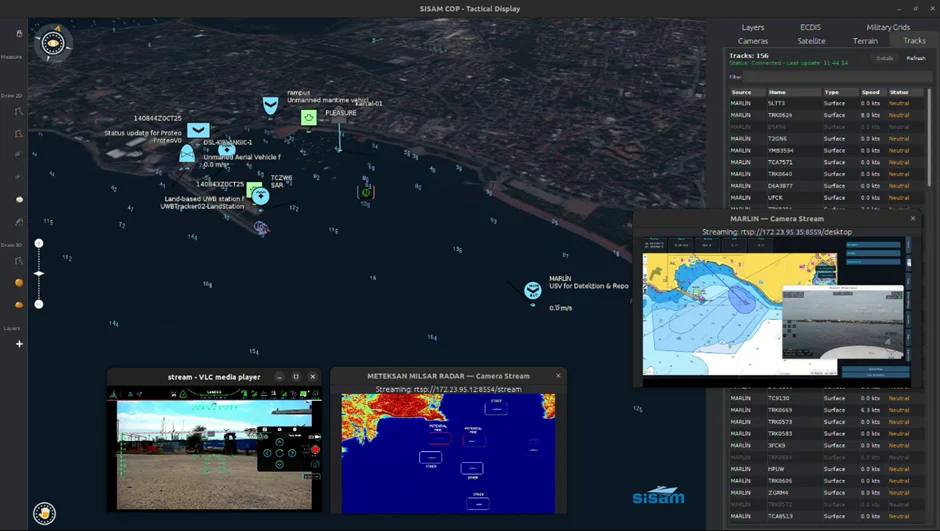
SISAM developed the COP using Octave Alto Embedded Lightspeed (formerly LuciadLightspeed) to display data and positional feeds from multiple unmanned vehicles (UxVs), with data ranging from synthetic aperture radar (SAR) images to video. The new STANAG 4817 was used, which is a NATO interoperability standardization study for multi-domain control of unmanned platforms. Using the STANAG 4817 approach enabled most participants to exchange multi-domain operations (MDO) information easily and implement new connections quickly over the cloud environment built by the NATO Communications and Information Agency (NCIA). For other participants, SISAM coded direct interfaces depending on sensor details.
With just over a month of development, the COP was used repeatedly by the demonstration coordinator from NATO Allied Command Transformation (ACT) to control demonstrations during SHINE. Our partner, SİSAM, demonstrated how easy it is to work with Alto. It combined the COP with its deep knowledge of naval warfare and unmanned maritime systems. The pace for developing such a capability was validated, with new sensors and UxVs added to the COP during the exercise. The development process was seamless, and the learning curve was minimal thanks to the intuitive Alto SDK environment.
The detection systems for both demonstrations were built entirely using commercial off-the-shelf (COTS) hardware and software, incorporating deep learning and AI techniques to automate detection of the mine and intruders. The UxVs taking part included submersible gliders, surface vessels and rotorcraft. For the mine detection demonstration, AI was used on SAR data to identify possible mines, with positive identification coming from multiple video feeds on surface and air platforms. The intruders’ rigid inflatable boat (RIB) was spotted by a video feed mounted on a robotic dog patrolling the sea front and confirmed from a submersible vessel.
The COP integrated and fused the positions of the UxVs and their tracks as well as AIS information of commercial vessels in the area, based at the Maritime Faculty of Istanbul Technical University. Background data of maritime charts with S-57 styling, bathymetry and satellite imagery from Vantor gave a realistic view along with the real-time data feeds. Using APP-6D military symbology with modified labels for ease of identification gave a clear picture of the situation to the demonstration coordinator and the observers of the SHINE.
Alto
Octave provides a complete geospatial SDK for solution providers to build mission-critical systems. With standards and speed of development baked in, Alto offers a strong foundation for defence solutions.
Explore Octave’s geospatial solutions for defence