Engineering and management systems provider uses Octave tools for in-depth nozzle and piping analysis to ensure site safety
OLG Engineering, established in 1982, provides engineering and management services nationwide in the United Kingdom in petrochemical, oil & gas, pharmaceutical and general engineering industries.
Identifying goals
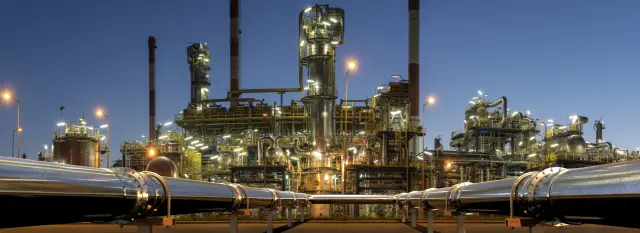
OLG Engineering provides engineering expertise to the piping and process industry and works closely with leading owner operators in the petrochemical industry. The company was employed to search for possible solutions to maintain piping system operations within a major oil refinery after fitness for service measurements revealed potential problems. During an inspection phase, a nozzle connection to a critical item of equipment (shell and tube heat exchanger) was found to be corroded. The plant owners were concerned that the remaining thickness to safely retain the fluid during operation was non-compliant with the site schedules and safety standards.
The owner operator wanted to avoid replacing the nozzle as this could be a time-consuming and potentially very costly due to the necessary system downtime. To avoid a plant outage, OLG Engineering needed to implement a fitness-for-service solution that enabled the heat exchanger and piping to safely remain in operation.
Overcoming challenges
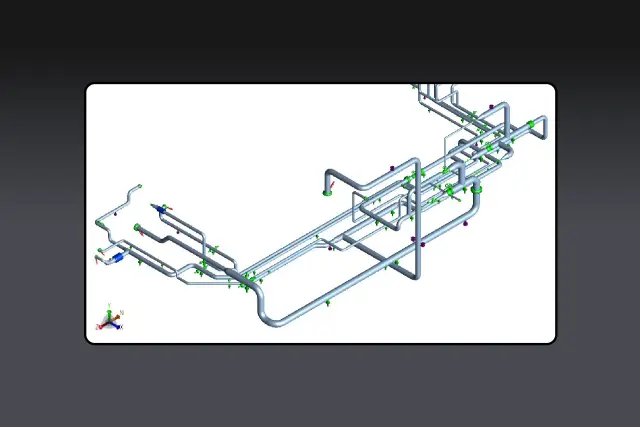
Aspect Pipe Stress was used to create a model of the entire piping system, including a connection from a tower to the heat exchanger nozzle. The main objective was to avoid any costly shutdowns and to have a better understanding of the current state of the piping system.
Initial modeling and analysis combined with a site inspection proved the whole system to be very sensitive to the stiffness values of nozzle connections and certain pipe supports. The challenge was to accurately calculate the stiffnesses of critical components at and close to the nozzle. This was significant in calculating accurate loads and stresses.
Outsourcing was not only more expensive, but it also meant that control over project timescales and completion was much more difficult. It also prevented the development of engineering expertise, a vital component in selling its services.
The successful implementation of Aspect Pipe Stress and NozzlePRO on this project provided OLG Engineering with expertise to expand its solution offerings to similar
in-depth projects in the future. The company is planning to further train its employees in Octave solutions and has already invested in FEATools™ to further facilitate more accurate analysis. The aim is to prevent unnecessary piping system modifications while ensuring compliance with site and national standards.
Realizing results
OLG Engineering implemented Aspect Pipe Stress for the qualification of piping systems in accordance with appropriate design codes to ensure compliance with site and industry standards. NozzlePRO supplemented the solution by carrying out local finite element analysis on pipe components, included on the pipe checks.
Using Aspect Pipe Stress and NozzlePRO, OLG Engineering found that the piping system in question was safe since the loads produced on the equipment nozzle using the more refined and accurate model were lower than the owner operator originally believed. The analysis showed that the nozzle connection was still compliant with site and industry standards, enabling the owner operator to avoid an unnecessary nozzle exchange and an unproductive and lengthy shutdown of the system.
Moving forward
Prior to using Aspect Pipe Stress and NozzlePRO, OLG Engineering outsourced such complex engineering projects to other third-party organizations because they require a high degree of accuracy and speed of analysis.
Outsourcing was not only more expensive, but it also meant that control over project timescales and completion was much more difficult. It also prevented the development of engineering expertise, a vital component in selling its services.
The successful implementation of Aspect Pipe Stress and NozzlePRO on this project provided OLG Engineering with expertise to expand its solution offerings to similar in-depth projects in the future. The aim is to prevent unnecessary piping system modifications while ensuring compliance with site and national standards.